
Genmitsu 3018-PRO Controller Board
SainSmart's Genmitsu board uses DRV8825 drivers in an ABS case and suits the 1810-PRO, 3018 and 3018-PRO.
- Control electronics
- Fits 3018-PRO

A replacement three-axis controller in the classic 3018 layout: an Arduino Nano-class ATmega328P running GRBL 1.1f, three A4988 stepper drivers, a spindle MOSFET and ports for laser, probe, E-stop and limit switches.
The MYSWEETY board is a like-for-like controller for the common 3018, 1610 and 1310 layout. An ATmega328P, the Arduino Nano chip, runs GRBL 1.1f; three A4988 drivers turn the steppers; a MOSFET switches the spindle; and a CH340 chip carries USB to the computer.
That is the same recipe many stock 3018 boards use, so a machine whose board has failed can go back to work with the same software and the same G-code. Candle, Universal Gcode Sender and GRBL Controller all talk to it over USB, on Windows XP to 10 or Linux.
Common reasons to fit one:
The board also covers machines beyond the 3018. MYSWEETY names the 1310, 1610-PRO, 3018, 3018-PRO and 3018 MAX, all small three-axis routers with Nema17 steppers and a brushed spindle.
Physical fit is rarely the problem. The board is transparent-cased and weighs 5 ounces. Most 3018 frames hold their boards on standoffs, so at worst a couple of new holes get it seated.
With a new board in, a first cut in pine or MDF confirms everything moves the right way. The 3018 basics cover machine and work coordinates if the axes need re-zeroing afterwards.
| Spec | Value |
|---|---|
| Brand | MYSWEETY |
| Firmware | GRBL 1.1f |
| Processor | ATmega328P (Arduino Nano) |
| USB interface | CH340 USB-serial |
| Axes | 3 (X, Y, Z) |
| Stepper drivers | A4988 |
| Stepper current | 2 A maximum, 1.5 A or less recommended |
| Motors supported | Nema17 and Nema23 steppers |
| Input voltage | 24 V DC (text also lists 12–24 V) |
| Power connector | 5.5 × 2.5 mm DC jack, power switch |
| Spindle drive | MOSFET, current within 10 A |
| Spindle power | 150 W |
| Spindle speed control | PWM |
| Laser support | 3-pin and 2-pin laser modules |
| Limit, probe and E-stop ports | 2-pin each |
| Module and spindle ports | 3-pin module port, 2-pin spindle port |
| Software | GRBL Controller, Candle, Universal Gcode Sender |
| Operating systems | Windows XP, 7, 8, 10 and Linux |
| Machines named | 1310, 1610-PRO, 3018, 3018-PRO, 3018 MAX |
| In the box | Controller board, USB cable |
The board's ratings decide which machines and upgrades it can run. They are modest, and they match a standard 3018 closely.
| Part | Rating | What it means on a 3018 |
|---|---|---|
| A4988 drivers | 2 A maximum, 1.5 A recommended | Fine for 3018 Nema17s; add a fan above 1.5 A |
| Input | 24 V DC, 5.5 × 2.5 mm jack | Matches the usual 3018 brick |
| Spindle MOSFET | Within 10 A, 150 W spindle | Runs a 775 motor; not a 300–500W spindle |
| Speed control | PWM | Spindle speed from the S word in G-code |
The input voltage needs a word. The board's description says it supports only 24 V DC input, while another line lists 12–24 V. Treat 24 V as the design voltage, since that is what a standard 3018 supply delivers.
The A4988 is a simpler driver than the DRV8825 on Genmitsu's board: it microsteps to 1/16 rather than 1/32. It handles the 1.3–1.5 A that typical 3018 Nema17s draw.
The spindle port is sized for a 775-class motor. A 300W or 500W spindle needs its own power supply and speed controller, driven from the board's PWM signal.
Spindle options that suit this board sit in the 3018 upgrade order under spindles and supplies.
A new board arrives with GRBL's defaults, not your machine's calibration. The quickest recovery is to copy the old settings across before the old board goes in the drawer.
The settings that matter most on a 3018:
If the old board is dead and no list survives, the machine's manual usually prints its defaults. Otherwise, calibrate steps per millimetre by commanding a 100 mm move and measuring what the machine does.
The 3018 software rundown shows where the console sits in Candle and UGS.
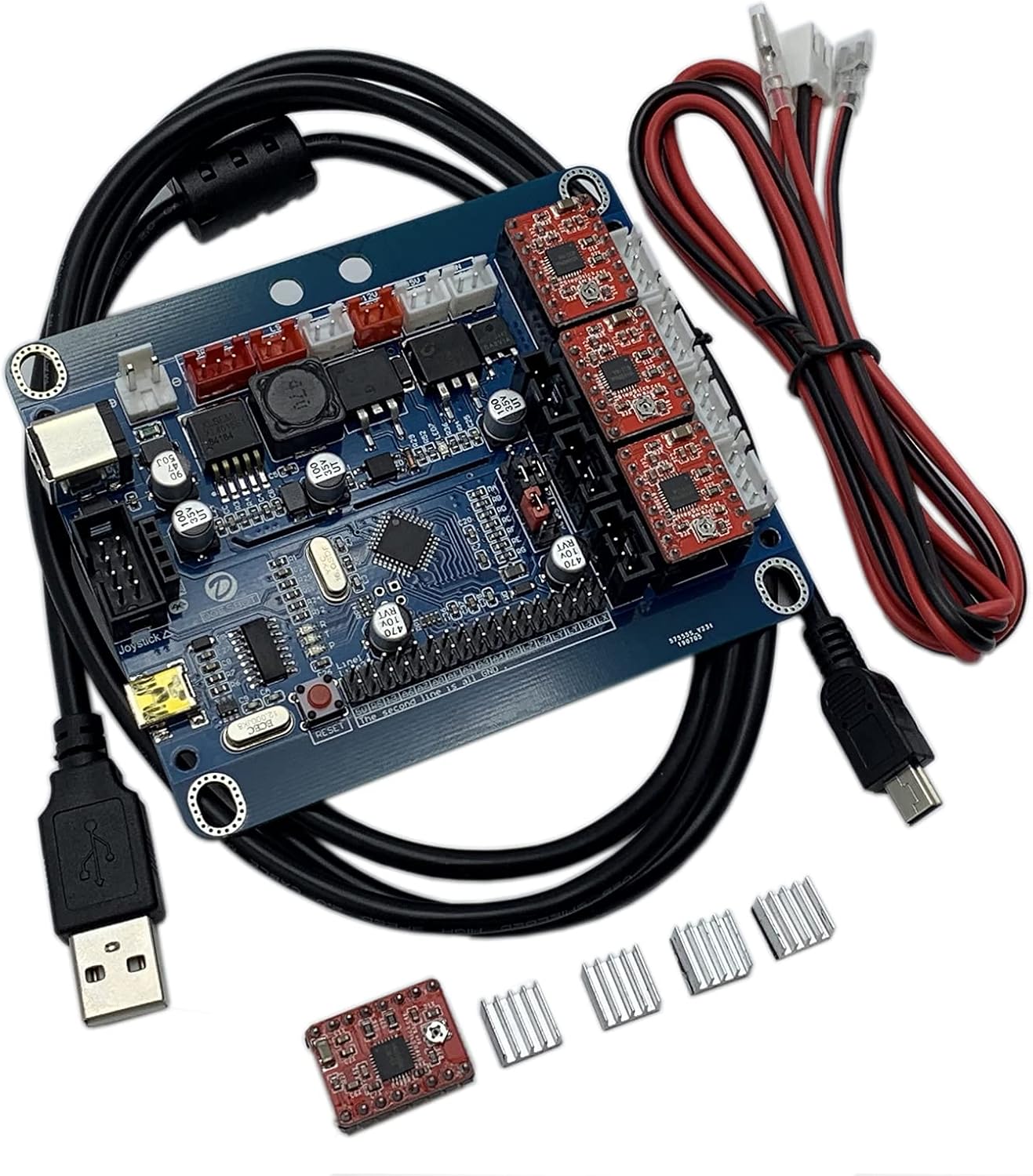

Four boards compete to run a 3018. They split into two families: 8-bit GRBL boards that replace a stock controller directly, and 32-bit boards that add features.
| Board | Drivers | Input | Extras |
|---|---|---|---|
| MYSWEETY GRBL 1.1f | A4988 | 24 V | E-stop, probe, limits, 2- and 3-pin laser |
| Genmitsu 3018-PRO board | DRV8825 | 24 V (12–24 V) | ABS case, 2- and 3-pin laser |
| Doesbot GRBL 1.1 | A4988 | 12–24 V | Dual-Y option, external offline controller |
| MKS DLC32 V2 | 32-bit | Not stated | Wi-Fi, TS35-R LCD, offline control |
Among the 8-bit boards, the differences are small. The Genmitsu board is drawn for Genmitsu machines and comes in an ABS case; the Doesbot can drive two Y motors; the MYSWEETY is the plain three-axis replacement.
The MKS DLC32 is a different step: a 32-bit board with Wi-Fi and a touchscreen in the kit. It needs more setup and suits owners who want to run jobs from a phone or a panel.
The 8-bit boards also share GRBL's limits. They run three axes, stream G-code over USB and store settings in the chip, and none adds a network or screen. For a 3018 cutting wood, plastics and PCB, that is all the machine needs.
Checks before ordering:
It targets the 3018, 3018-PRO and 3018 MAX layout with Nema17 steppers and a 775 spindle. Check your supply is 24 V with a 5.5 × 2.5 mm plug.
An ATmega328P, the Arduino Nano chip, running GRBL 1.1f, with a CH340 for USB.
Yes. It supports 3-pin lasers on the module port and 2-pin lasers on the white + S- plug.
Not directly. The spindle MOSFET suits a 775-class motor; a 500W spindle needs its own supply and controller fed from the PWM signal.
Yes. Save the old $$ list first, or recalibrate steps per millimetre with a measured move.