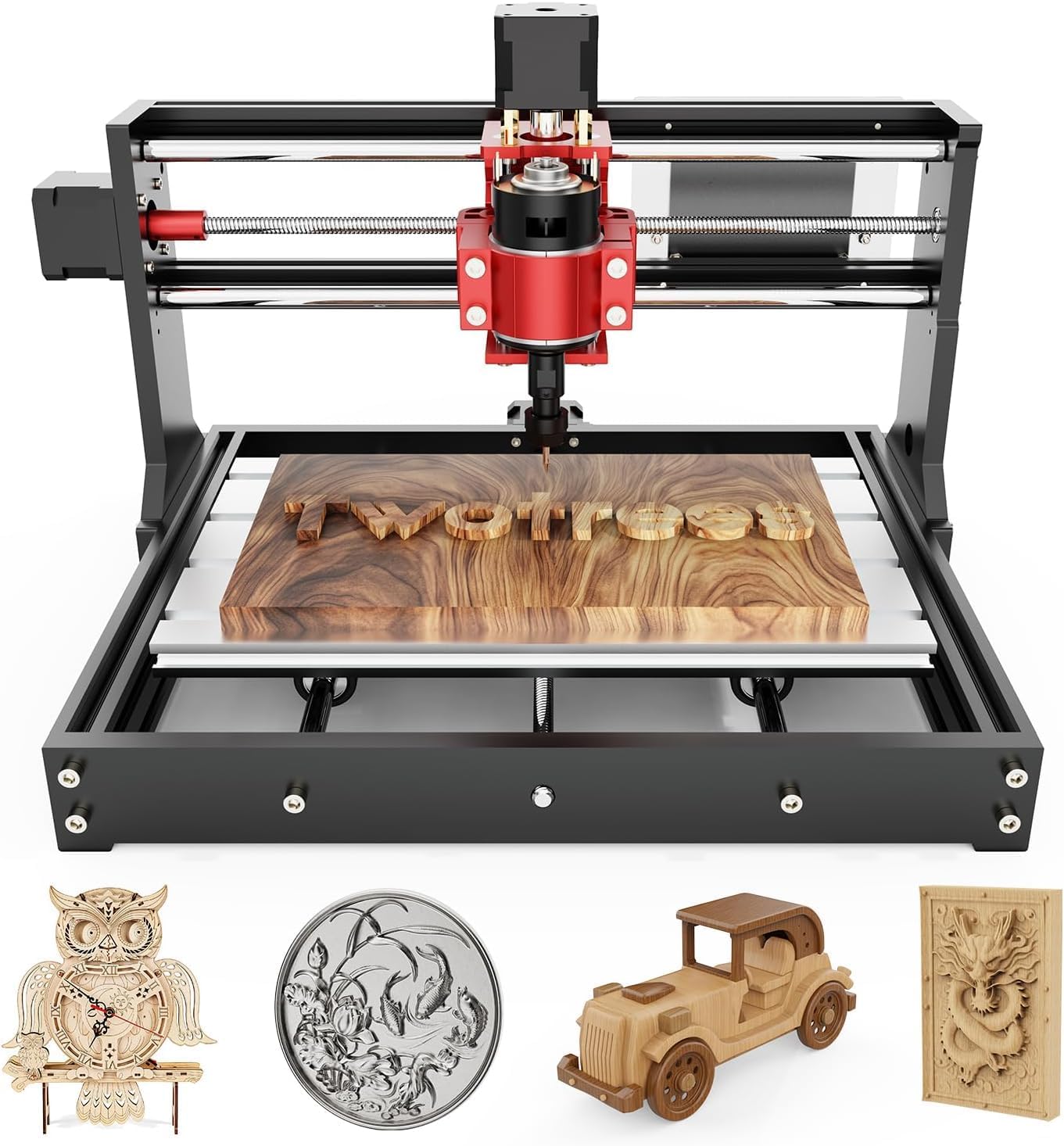
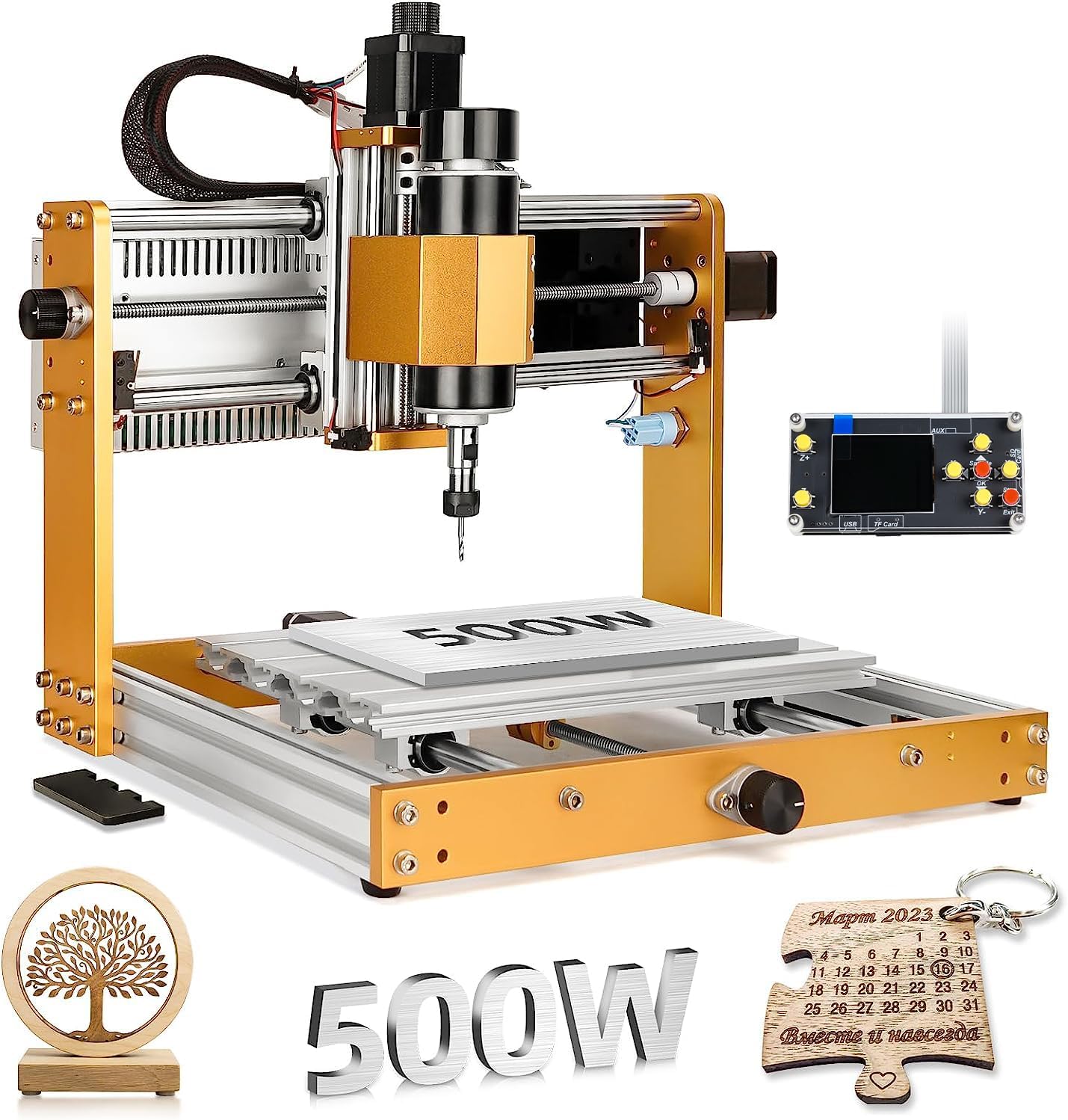
- 300 × 180 × 45 mm
- 775 brushed spindle, ER11 collet
- Offline controller: runs without a PC
A desktop router with about 300 mm of X travel, 180 mm of Y and a small spindle, steered by GRBL firmware. It carves wood, plastics and copper-clad board, and it skims soft aluminium when every pass stays shallow.
Logged September 2026A 3018 CNC machine is a three-axis desktop CNC router named after its 30 × 18 cm working area. Stepper motors on T8 lead screws move the bed and the spindle, a GRBL board reads G-code over USB, and an ER11 collet holds small-shank bits. It suits wood, acrylic, PVC, PCB and light aluminium work.
The name is the size. A 3018 moves its spindle about 300 mm left to right and its bed about 180 mm front to back, and the number belongs to the frame design rather than to any one brand.
Almost every 3018 is built the same way. The bed rides on two guide rods and carries the stock toward and away from you, which is the Y axis. A gantry bridges the bed and carries the Z carriage sideways along X, and the carriage lifts the spindle for Z.
Frames split into two families. Moulded or bakelite side plates with an aluminium bed describe the classic 3018-PRO and its copies. All-metal machines such as the LUNYEE 3018 Pro Max swap plastic for aluminium profile and add Z travel.
None of this makes it a milling machine. The rods flex, the spindle is small, and depth per pass stays well under a millimetre in anything harder than pine.
| Material | Bit | Feed | Depth per pass | Watch for |
|---|---|---|---|---|
| Pine and other softwoods | 1/8-inch 2-flute flat end mill | 500–800 mm/min | 0.5–1.0 mm | Fuzz on the grain; a downcut bit leaves a cleaner top |
| Birch plywood | 1/8-inch 2-flute or downcut | 400–700 mm/min | 0.5–1.0 mm | Glue lines dull bits faster than solid wood |
| MDF | 1/8-inch 2-flute | 500–800 mm/min | 0.5–1.0 mm | Fine dust; run a shoe and a vacuum |
| Oak, walnut, maple | 1/8-inch 2-flute | 300–500 mm/min | 0.3–0.6 mm | Burn marks when the feed drops too low |
| Cast acrylic | Single-flute O-flute | 300–600 mm/min | 0.3–0.5 mm | Melting and re-welded chips; clear chips with air |
| PVC foam board, HDPE | Single-flute | 400–800 mm/min | 0.5–1.0 mm | Stringy chips wrapping the bit |
| FR1 or FR4 copper-clad | 20–30° V-bit, 0.1 mm tip | 100–200 mm/min | 0.05–0.1 mm | Uneven boards; probe a height map first |
| 6061 aluminium | Single-flute carbide | 100–250 mm/min | 0.1–0.2 mm | Chips welding to the flute; use lubricant or air |
| Brass | Single- or 2-flute carbide | 100–200 mm/min | 0.05–0.15 mm | Chatter on a flexible frame |
Common starting points for a 1/8-inch carbide bit in a stock 775 spindle near 10,000 rpm. Stiffer 500W frames take deeper passes; frame, bit sharpness and stock clamping all move the numbers, so test on scrap first.
Wood is where a 3018 earns its keep. Softwoods and plywood cut clean at moderate feeds, and MDF gives the smoothest pocket floors of all, at the cost of fine dust that gets everywhere.
Hardwoods ask for patience. Oak and maple push back hard on a 775 spindle, so passes get shallower and feeds slower, and burn marks appear if the bit rubs instead of cutting. Walnut and cherry carve beautifully for inlays and small boxes once the depth drops to a few tenths of a millimetre.
Plastics split by how they melt. Cast acrylic chips cleanly with a single-flute bit and enough feed to keep heat moving out with the chip. Extruded acrylic, softer and gummier, tends to weld back into the slot.
For every material, the starting feeds and depths in the material table are a floor to build from. Change one number at a time and write down what the next pass sounds like.
Genmitsu 3018-PRO CNC Router Kit |
Twotrees TTC3018 CNC Router |
Twotrees TTC3018 Pro CNC Router |
Genmitsu 3018-PROVer V2 CNC Router |
LUNYEE 3018 Pro Max 500W CNC Router |
VEVOR 3018 CNC Router | |
| Type | Machine | Machine | Machine | Machine | Machine | Machine |
| Spindle | 775 spindle | 775 spindle | 775 spindle | 775 spindle | 500W spindle | 60W spindle |
| Work area | 300 × 180 × 45 mm | 300 × 180 × 40 mm | 300 × 180 × 40 mm | 284 × 180 × 41 mm | 300 × 180 × 80 mm | 300 × 180 × 40 mm |
| Frame | Aluminium + plastic | Aluminium + plastic | All-metal | All-metal | All-metal | Aluminium + plastic |
| Linear guides | No | No | No | No | No | No |
| Offline controller | Yes | Not included | Not included | Not included | Yes | Not included |
| Get it here | Get it here | Get it here | Get it here | Get it here | Get it here |
GRBL keeps two sets of numbers. Machine coordinates, shown as MPos, describe where the carriage sits on the frame; work coordinates, shown as WPos, describe where it sits relative to the corner of your stock.
On a 3018 with limit switches, the homing cycle drives each axis to its switch and sets machine zero there, so MPos means the same point every session. Without switches, machine zero is simply wherever the carriage stood when the board powered on. That is why owners of switchless kits zero everything by hand before each job.
The offset lives in G54 until it is changed, which is handy when a job stops halfway. On a homed machine, re-homing brings the carriage back to the same MPos and the stored G54 offset puts the bit back over the same corner.
A Z-probe tightens step three. The SainSmart touch probe lets GRBL lower the bit until it touches a plate of known thickness, which beats sliding paper under a spinning end mill. Soft limits, set with the travel values in the GRBL settings, only work once homing gives machine coordinates a fixed origin.
Limit switches let GRBL home the PROVer V2 to the same machine zero every session, so work offsets and soft limits mean something. The gantry and the one-piece aluminium spoilboard arrive assembled.
Get it hereCopper-clad board is the 3018's party trick. A V-bit scrapes a thin trench around each trace, isolating it from the rest of the copper, and a board designed in the afternoon can be drilled and soldered by evening.
The trench is only a few hundredths of a millimetre deep, so a board that bows by 0.1 mm ruins it. Candle's height map probes a grid across the copper and bends the toolpath to follow the surface. FR1, the paper-based board, is kinder to bits and lungs than glass-fibre FR4, whose dust should be vacuumed rather than blown.
A 3018 CNC PCB milling machine works in three stages, each with its own bit.
Aluminium is possible and slow. Makers of 775 kits list soft aluminium and copper among their materials, and a sharp single-flute carbide bit at 0.1 to 0.2 mm per pass will cut engraved plates, thin brackets and panel openings. Lubricant or an air blast keeps chips from welding to the flute.
The frame sets the ceiling. A 500W all-metal machine with a stiffer Z, such as the LUNYEE Pro Ultra on its HGH15 linear guide, holds the bit steadier in 6061 and brass than a moulded-plate kit can. Steel, glass, stone and ceramics stay off every 3018.
A first project should teach one thing at a time. A flat coaster teaches facing and zeroing; a name sign teaches V-carving; a small box lid teaches pockets and outlines with tabs.
Clamp everything harder than seems necessary. A 3018 bed is small, the clamps sit close to the cut, and a part that shifts half a millimetre spoils the whole job. Low-profile side clamps or T-track hold-downs keep clear of the bit.
Write each job down: material, bit, feed, depth, rpm and what went wrong. After ten entries the pattern shows which settings suit your frame. The software notes cover the programs, and the upgrade order lists the parts that make the next ten jobs easier.
The working area: about 30 cm of X travel and 18 cm of Y. Larger siblings use the same code, such as the 4040 at roughly 40 × 40 cm.
Yes, in several passes. Plan 0.5 to 1 mm per pass with a 1/8-inch bit and leave small tabs so the part stays put until the last pass.
It is among the jobs 3018 owners do most. A V-bit isolates the traces, and a height map probed across the board keeps the shallow cut even.
MPos is the carriage position on the frame, fixed by homing when limit switches are fitted. WPos is the position relative to your stock, set when you zero X, Y and Z.
No. The frame and spindle suit wood, plastics, PCB and light passes in soft aluminium, brass and copper. Steel, glass, stone and ceramics need a different machine.