A clip on the bit, a puck under it and a probe cycle in Candle or UGS: Z zero lands in seconds, the same way every time. Made for the 3018-PRO and 3018-PROVer and works with GRBL and Mach3.
Get it hereA stock 3018 cuts well once the bit is zeroed quickly, the stock is clamped hard and the bed is flat. Those parts come first; faster spindles, longer beds and lasers follow.
Logged September 2026Cheap parts that save setup time and ruined stock go first, then the ones that protect the machine, then the ones that add capacity. Check spindle diameter and the exact model name before ordering any mount, shoe or spoilboard.
A clip on the bit, a puck under it and a probe cycle in Candle or UGS: Z zero lands in seconds, the same way every time. Made for the 3018-PRO and 3018-PROVer and works with GRBL and Mach3.
Get it hereThe two most common ways to ruin a 3018 job cost almost nothing to fix. One is a Z zero set by eye or paper slip; the other is stock that shifts under the bit halfway through the pass.
A touch probe turns zeroing into a routine. A clip goes on the bit, a plate of known thickness sits on the stock, and a probe cycle in Candle or UGS lowers Z until the circuit closes. GRBL subtracts the plate thickness and sets zero, and it lands the same way after every bit change.
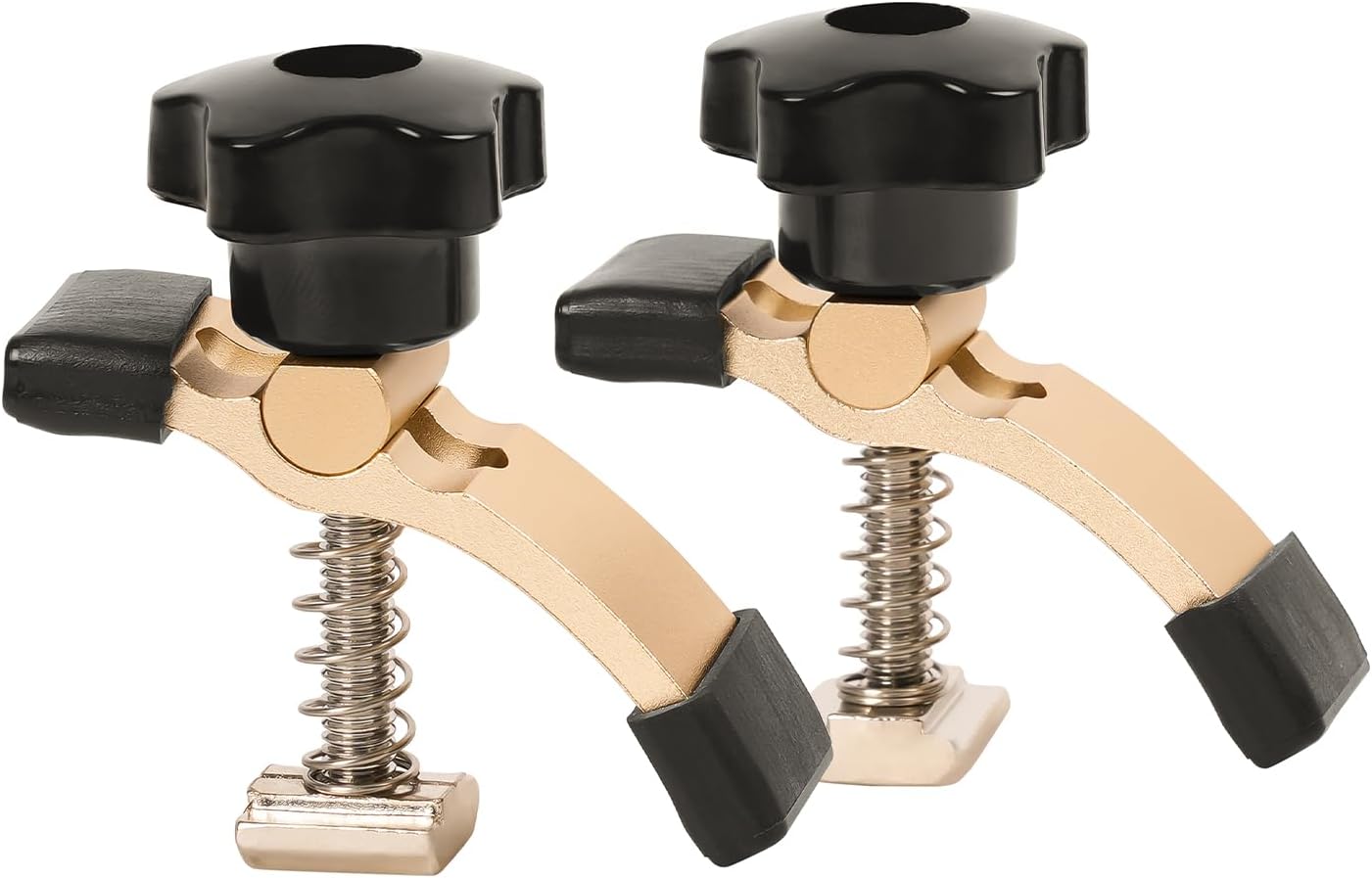
Clamps come next. The clamps in most 3018 kits are simple straps that rise above the work. Low-profile side clamps grip from the edge with a serrated tiger-claw face, leaving the whole top surface free for a facing pass.
The Fuzqq four-pack fits M6 spoilboard holes and T-track. LUNYEE's tiger claws are sized for its Pro Max and Pro Ultra tables, and Genmitsu's T-track mini hold-downs take stock up to 1.77 inches thick. Two clamps hold a coaster blank; four hold a thin plate flat against chatter.
Four aluminium tiger-claw side clamps grip from the edge and sit below the top face, so a surfacing pass never meets a clamp. They bolt to M6 spoilboard holes or to T-track.
Get it here
The aluminium bed of a 3018 is not a cutting surface. A 12 mm MDF spoilboard screwed on top gives the bit somewhere to finish a through-cut and can be surfaced flat with a wide bit whenever it gets scarred.
Surfacing is the trick. A skim of 0.3 to 0.5 mm across the whole board makes it exactly parallel to the gantry's travel, which matters more than the board's factory flatness. Keep MDF dry: Doesbot warns against oils and coolant, which swell the fibres.
Limit switches change what the machine knows. With six micro switches wired to the board and homing turned on, GRBL finds a fixed machine zero, soft limits stop jogs before they crash, and a stopped job can be resumed at the same spot. Switch kits come as plain six-packs of normally open switches with 1 m cables, or bundled with an E-stop.
The CNCTOPBAOS switch and E-stop kit targets the 3018-PRO, Pro-Max and Plus frames with 80 cm leads. Genmitsu owners of a PROVer or MX3 have the Essential Accessories Kit, which bundles a stop button, a probe and six switches.
A stock 775 spins at roughly 9,000 to 10,000 rpm on 24V. Small bits want more surface speed than that, and the Genmitsu GS-775M doubles the top speed to 20,000 rpm in the same 775 body.
More rpm lets a 1/8-inch bit take a finer chip at the same feed, which means cleaner edges in wood and acrylic and less heat in the cut. The GS-775M has double ball bearings, a noise-suppression board already fitted and a 5 mm shaft with an ER11 collet set.
The supply is the catch. A faster 775 draws a big current at start-up, and older 3018 bricks can sag and reset the board. Genmitsu's upgraded 24V 4A adapter is rated for an 8 to 10A starting current, and a bundle pairs it with the spindle. Genmitsu also asks owners to check whether their supply is the old version before buying.
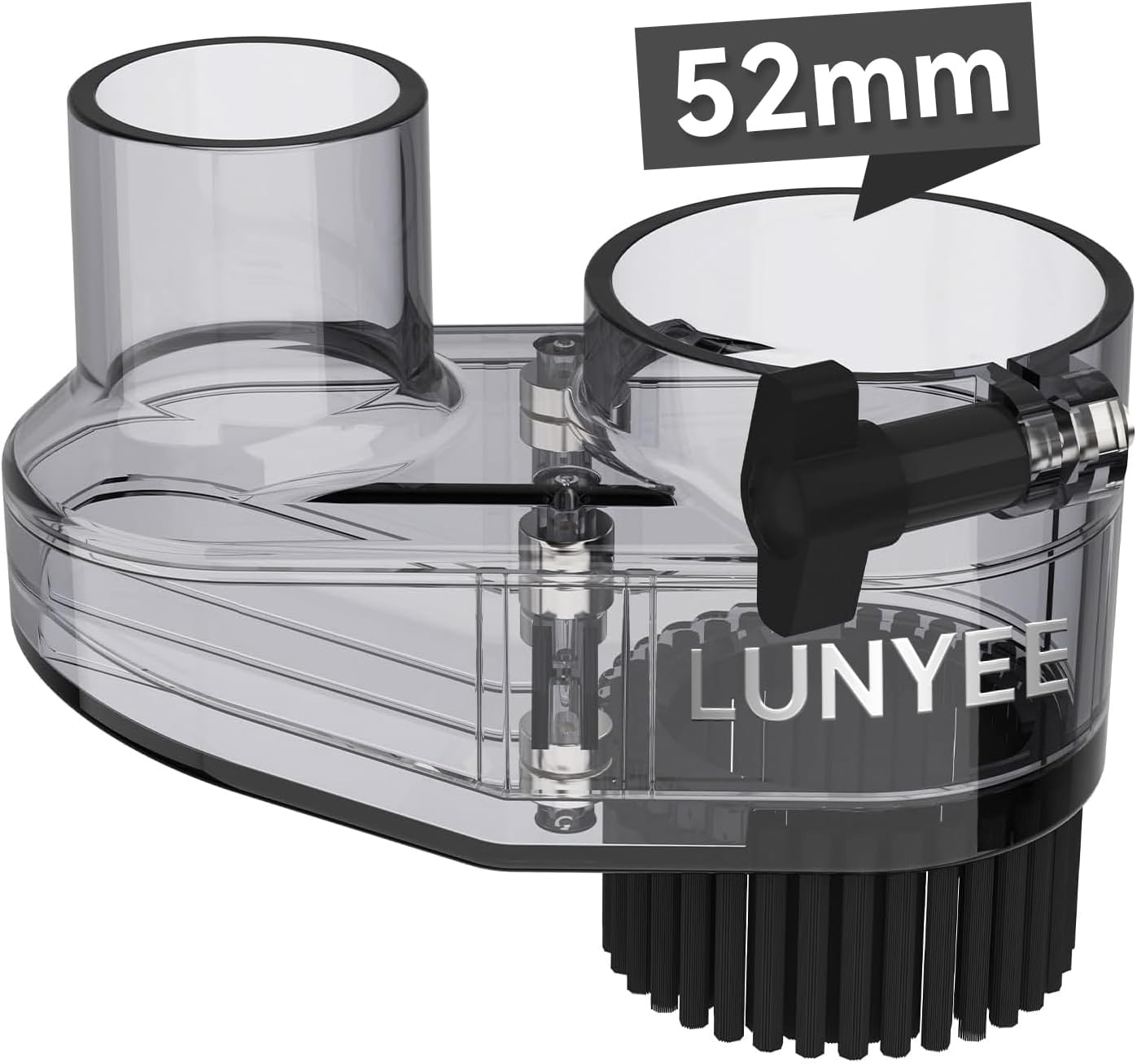
Zhong Hua Jiang's 775 is a lower-cost 20,000 rpm alternative rated for 12 to 24V. Either motor then wants a 42 mm dust shoe, whose magnetic bottom pops off for bit changes without tools.
| Part | Size or spec | Made for | Check before fitting |
|---|---|---|---|
| SainSmart Z-axis probe | Touch plate and clip, GRBL or Mach3 | 3018-PRO, 3018-PROVer | A probe port on the board |
| Genmitsu photoelectric probe | Blue and red indicator LEDs | 3018-PROVer V2, 4040-PRO, 3020-PRO | V2-series wiring |
| Genmitsu MDF spoilboard | 300 × 180 × 12 mm, M6 holes | 3018-PRO and most 3018 frames | Hole spacing on the aluminium bed |
| LUNYEE MDF spoilboard | 300 × 180 × 12 mm grid, 24 holes | 3018 Pro Max, 3018 Pro Ultra | Hole spacing on other frames |
| Genmitsu dust shoe | 42 mm spindle, 38 mm hose | Most 775-spindle 3018s | Two 4 mm screw holes on the mount |
| LUNYEE dust shoe | 52 mm spindle, 38 mm hose | 3018s with 52 mm spindles | Spindle diameter |
| Genmitsu GS-775M | 24V, 20,000 rpm, 5 mm shaft, ER11 | All 3018 series | A 24V supply able to start it |
| Genmitsu Z assembly V2 | 43 and 52 mm mounts, Z range 56 mm | 3018-PRO; separate PROVer version | The model on the box |
| Genmitsu spindle holder | 65 or 69 mm diameter | 3018-PRO, PROVer V2 with Z assembly V2 | Trim-router body size |
| Genmitsu 3018 Y kit | Y extended to the 3040 size | 3018-PRO, 3018-MX3 | The PROVer V2 has its own kit |
| PROVer V2 Y kit | Adds 220 mm, 420 mm total Y travel | 3018-PROVer V2 only | Matching 3040 spoilboard |
| Daedalus X/Y kit | Y from 290 to 450 mm frame length | T8 screw, 10 mm rails | Longer Y limit-switch cable |
| Micro limit switches | 6 × NO, 1 m 3-pin cables | 3018-PRO or 3018-PROVer and MX3 sets | Board limit ports |
| Genmitsu 24V supply | 24V 4A, 8–10A start current | 3018-PRO, 3018-PROVer | Barrel plug on the board |
Fit data from each maker's compatibility notes. 3018 frames from different makers vary in rod diameter, screw lead and hole spacing, so a part named for one model may need drilling on another.
Past the 775 lies a different class of spindle, and the moulded Z carriage of a basic 3018 was never built to hold one. A stronger spindle needs a stronger carriage first.
Genmitsu's Aluminium Z Axis Assembly V2 replaces the carriage with a machined aluminium one. It holds a 775 in a 43 mm mount or a 300–500W spindle in a 52 mm mount, and the V2 lowers the mount to raise effective Z range from 40 to 56 mm. Limit switches and linear bearings come fitted, and a knob on top turns Z by hand.
A 500W spindle usually comes with its own power supply and speed controller, so budget space on the bench and wiring time. The 3018 board then switches it on and off or passes PWM to that controller.
This is also where a fresh machine starts to make sense. The all-metal 3018 Pro Max frames ship with a 500W spindle and 80 mm of Z, which is what this whole upgrade path builds toward.
The 180 mm Y axis runs out first. A sign longer than a hand's span, a guitar pickguard or a full-size cutting board needs more travel, and the extension kits add it without a new machine.
Each extension needs a bed to match. Genmitsu's 3040 T-slot aluminium spoilboard suits its 3018-PRO kit but not the PROVer V2, which has its own 3040 extension spoilboard. A 30 × 36 cm MDF board covers the 3018-PRO and MX3 build. The Daedalus kit also asks for a longer Y limit-switch cable.
The laser comes after the bed, not before, because a diode head works best on a flat, surfaced spoilboard. The laser module notes compare the 5W, 5.5W and 10W choices.
The rest can wait until a job asks for it: the KABA Lite enclosure for dust and noise, the 184 mm rotary module for the PROVer V2, an MPG handwheel for jogging, or a Wi-Fi module for sending files from a phone.
A Z touch probe and a set of low-profile clamps. Together they fix the two most common causes of scrapped parts: a wrong Z zero and stock that moves.
The GS-775M is a 775-size motor for all 3018 series machines, so it drops into the stock clamp. Pair it with a 24V supply rated for its starting current.
Many do, because the frame is a shared design. Rod diameter, screw lead, hole spacing and spindle diameter still vary, so check those before ordering.
Fit a Y-axis extension kit for your exact model, plus a matching 3040 spoilboard. X stays at about 300 mm on every kit.
Yes, with an aluminium Z carriage and a 52 mm mount, plus the spindle's own supply and speed controller. The Genmitsu Z assembly V2 is built for it.