
Genmitsu GS-775M Spindle Motor
Genmitsu's GS-775M runs 20,000 rpm at 24V with a suppression board and an ER11 collet set.
- Spindle upgrade
- 24V
- Fits most 3018 machines
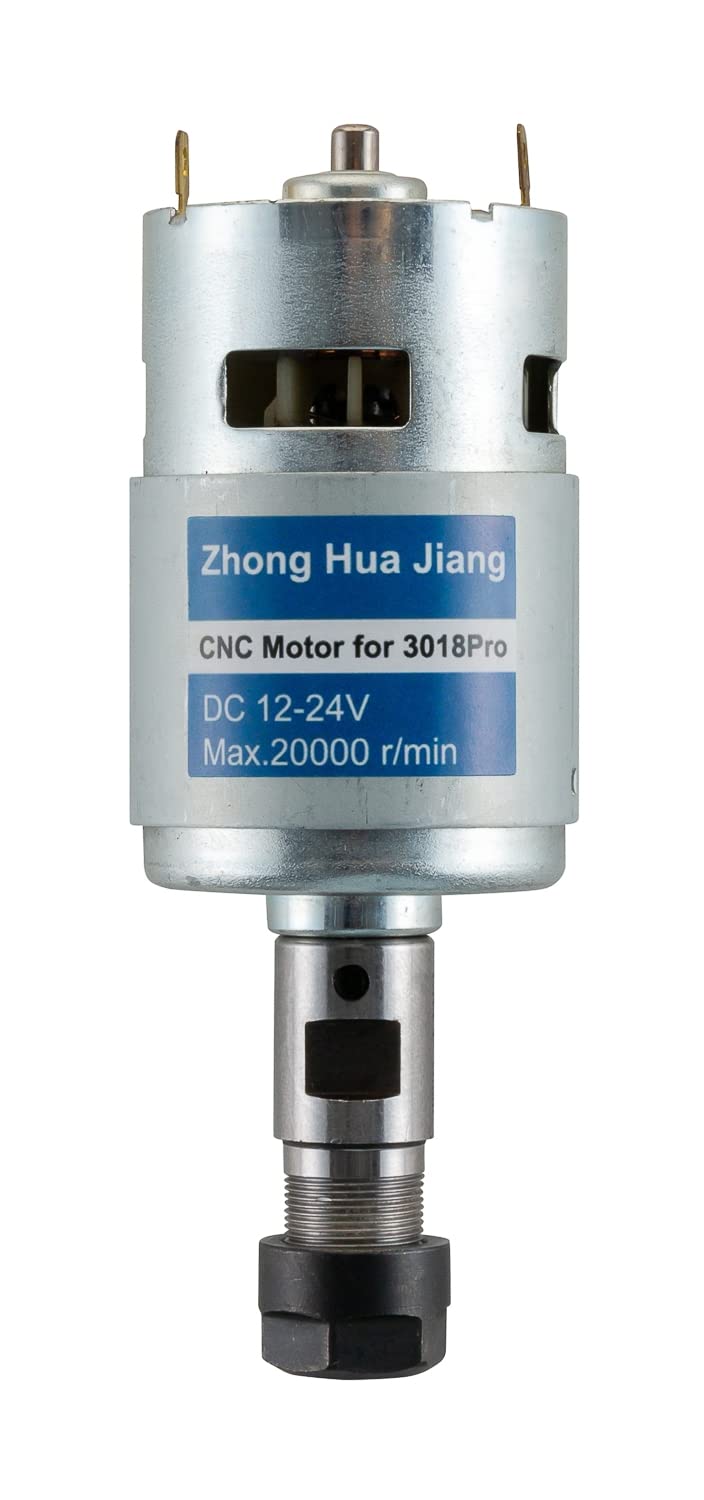
A replacement 775 motor for 3018 routers, rated 20,000 rpm on 12–24V DC, with double ball bearings and a 5 mm ER11 extension shaft already fitted.
Almost every entry-level 3018 is built around a 775 DC motor: a compact brushed can with a collet adapter on its shaft. The Zhong Hua Jiang motor is a direct replacement of that type. It is rated at 20,000 rpm on 24V and runs anywhere from 12 to 24V DC.
Its selling points fit in a short list:
For context, Twotrees quotes 7,000–9,000 rpm for the 775 on its TTC3018. A 20,000 rpm rating is more than double even Twotrees' upper figure, which matters most for small-diameter bits.
Two situations make this motor worth ordering. The first is a stock spindle that has grown loud, slow or rough, which on a brushed 775 usually means worn brushes or bearings. The second is an owner who wants more rpm for fine engraving without rebuilding the Z carriage. In both cases the motor drops into the existing 775 holder, and nothing else on the machine has to change.
| Spec | Value |
|---|---|
| Maker | Zhong Hua Jiang |
| Part number | 775 motor |
| Motor type | 775 brushed DC motor |
| Bearings | Double ball bearings |
| Voltage range | DC 12–24V |
| Rated voltage | 24V |
| Rated speed | 20,000 rpm |
| Speed control | Adjustable through software (PWM from the control board) |
| Motor shaft | 5 mm |
| Tool holding | ER11 extension shaft on the 5 mm motor shaft |
| Compatibility | 3018 series CNC routers, including the 3018-PRO |
| Maker's life claim | Twice the working life of an ordinary 775 |
| In the box | 1 motor with ER11 extension shaft |
Spindle speed matters because of chip load. Multiply spindle speed by the flute count and the chip each flute should take, and the product is the feed; the faster the spindle turns, the faster a small bit can move while still cutting a proper chip. On a light 3018 frame, where feeds are already modest, more rpm widens the range of workable settings.
Where the higher speed shows first:
Speed has a flip side. A fast spindle with a slow feed rubs instead of cutting, and plastics punish that first: acrylic softens, welds onto the bit and fuses the slot. If chips come off as dust or melted strings, raise the feed or lower the spindle speed until they come off as clean curls.
| Material | Bit | Watch for |
|---|---|---|
| FR4 board | V-bit, 0.1 mm tip | Uneven Z zero across the board |
| Cast acrylic | Single-flute end mill | Melting at low feed |
| Walnut | V-bit or 1/8 in flat | Burn marks on slow corners |
| Soft aluminium | Single-flute end mill | Chatter; keep passes very shallow |
Aluminium stays marginal on any 775, however fast it spins. The motor has speed but little torque, and the rest of a basic 3018 flexes before the motor stalls. Settings by material are in the materials entry.
Fitting the motor takes a hex key, a few minutes and some care with the wires. The steps below apply to the stock 775 holder on a 3018-PRO-type Z carriage.
Check the direction of rotation before cutting anything. Standard end mills and V-bits are right-hand cutters and need clockwise rotation seen from above. On a brushed DC motor, swapping the two wires reverses the direction, so a spindle running backwards is a two-minute fix.
Then set GRBL's maximum spindle speed to match the new motor, so PWM commands map onto its real range. Setting number 30 in the GRBL list holds that value; how to change it from Candle or UGS is on 3018 CNC software. Finally check the collet: runout on an extension shaft shows up as fuzzy slots and snapped small bits.


The 775 upgrade market is small and similar. The Genmitsu GS-775M is the obvious rival, and past both of them sits the larger jump to a 300–500W spindle in a 52 mm mount.
| Option | Speed and voltage | Extras | Mount |
|---|---|---|---|
| Zhong Hua Jiang 775 | 20,000 rpm, 12–24V | Double ball bearings, ER11 extension shaft | Stock 775 holder |
| Genmitsu GS-775M | 20,000 rpm, 24V | Noise suppression board, ER11 collet set, CW/CCW | Stock 775 holder |
| 300–500W spindle | Powered by a separate supply and speed controller | Much more torque | 52 mm clamp, usually a metal Z |
The Zhong Hua Jiang motor suits these owners:
Buy two if the machine runs every week. A spare 775 in the drawer turns a worn-brush failure on a Saturday into a ten-minute swap instead of a week without cutting.
The GS-775M suits owners who want the noise suppression already on the motor and a collet set in the box. Both motors are rated 20,000 rpm at 24V, so cutting results on wood and plastic will be close.
A 52 mm spindle is a different project: a metal Z carriage, a separate power supply and more weight on the gantry. It is the right step for regular aluminium and brass work. The upgrade order shows where each spindle step fits, and the aluminium Z assembly is the usual first move toward a 52 mm motor.
Yes, it is a 775 motor like the stock one and slides into the same holder. The maker lists every 3018 series router as compatible.
DC 12–24V, rated at 24V. Most 3018 controller boards supply 24V to the spindle, with speed set by PWM.
It comes with a 5 mm ER11 extension shaft on the motor. Check that your ER11 collets match the bits you use, most often 1/8 in.
Only lightly. It helps small bits cut soft aluminium in very shallow passes, but torque and frame stiffness limit metal work on a basic 3018.
Swap the two motor wires at the board. Reversing polarity reverses a brushed DC motor, and standard bits need clockwise rotation seen from above.