Top 3018s
Workholding · printed PETG · T-slot, M6

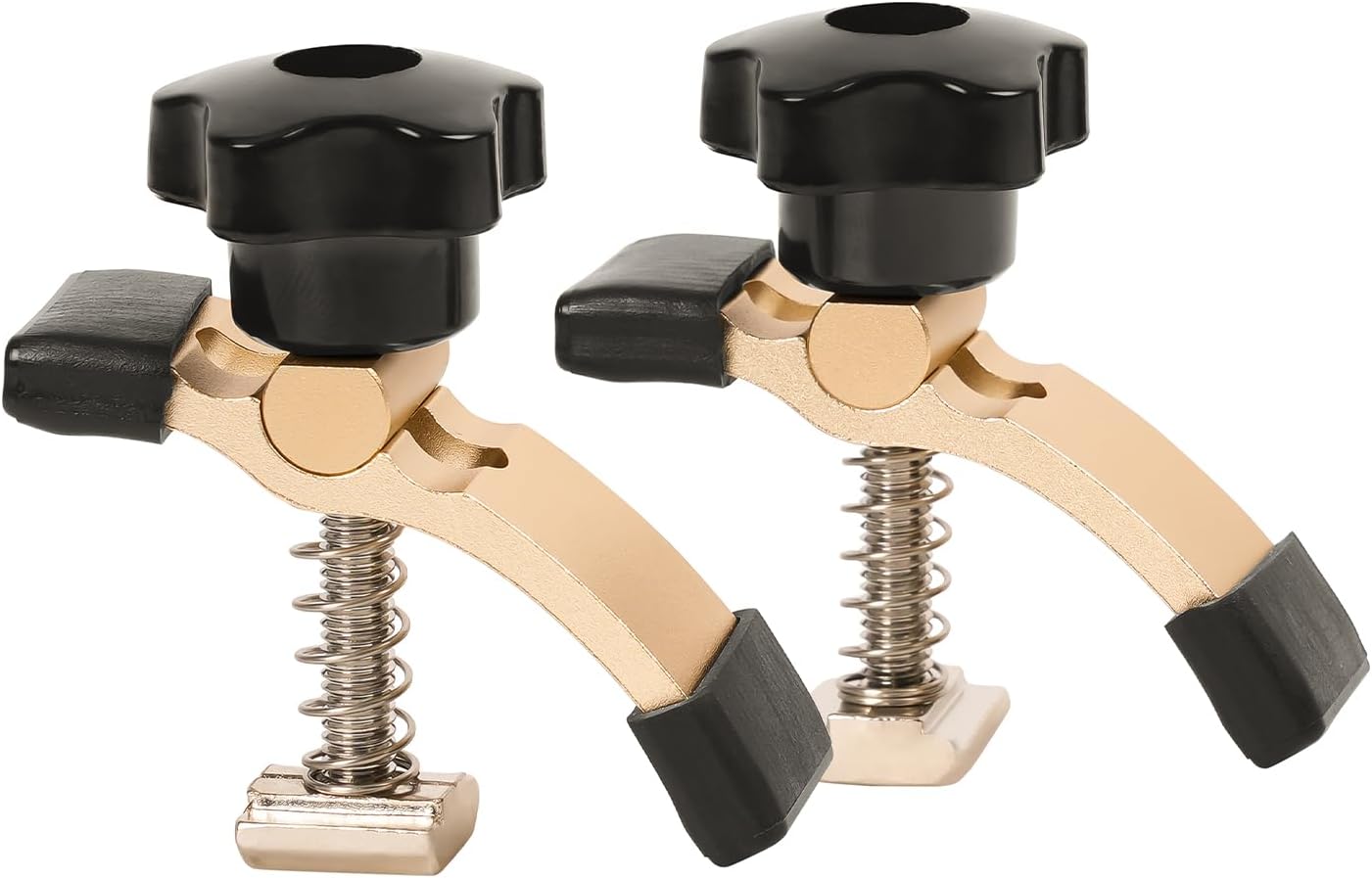
CEKPDGRT Clamp Kit for 3018-PROVer V2

A set of adjustable hold-down fixtures printed in PETG for T-slot tables, sold to fit the Genmitsu 3018-PROVer V2. Plastic jaws hold PCB, wood and plastic without scratching them.

  • MaterialPETG, 3D printed
  • FitsGenmitsu 3018-PROVer V2
  • TableT-slot worktables
  • FastenersStandard M6 bolts
  • BaseSlotted, positions anywhere
  • HoldsPCB, wood, plastic
Suits
  • PROVer V2 owners who want more hold-downs on the T-slot bed
  • PCB blanks and finished faces that metal clamps would mark
  • A clamp a stray bit can hit without snapping
Skip if
  • Heavy aluminium cuts that need a rigid metal clamp
  • Hot environments: PETG softens with heat
Get it here

PETG hold-downs for the PROVer V2's T-slot bed

The 3018-PROVer V2 has a one-piece aluminium spoilboard with T-slots, and every job on it starts with the same question: how to hold the stock down. This kit answers it with printed plastic instead of machined aluminium.

CEKPDGRT prints the clamps in PETG, a tough 3D-printing plastic, and sells them as a third-party part for the V2. Each one is an adjustable hold-down: a slotted baseplate that slides along an M6 bolt in the T-slot, and a clamping arm that presses the stock to the bed.

What sets printed clamps apart from the aluminium ones most 3018 owners buy first:

  • They do not scratch. A plastic jaw on a finished face or a PCB's copper leaves no mark.
  • They forgive a stray bit. A 1/8-inch end mill that clips a plastic clamp cuts into it; one that clips aluminium usually snaps.
  • They position freely. The slotted base can sit anywhere along the slot, and the M6 bolt sets the height.
  • They are light. Nothing heavy sits on the bed or loads the Y stepper.

The kit is designed for T-slot worktables and adjusts to most standard-sized workpieces. The description names PCB, wood and plastic as the stock it anchors, which lines up with where plastic clamps work best.

This is a third-party part, printed to fit the PROVer V2. Genmitsu does not make or endorse it, so fit questions go to CEKPDGRT, not Genmitsu.

Standard M6 bolts are the fastener, the same thread size used on most 3018 beds and clamp kits, so spares are easy to find in any hardware drawer.

Measurements

The spec log

SpecValue
BrandCEKPDGRT
ModelGeneric
MaterialPETG
Manufacturing3D printed
TypeAdjustable hold-down fixture set
Compatible machineGenmitsu 3018-PROVer V2
Table typeT-slot worktables
FastenersStandard M6 bolts
BaseplateSlotted, positions anywhere on the table
Workpieces namedPCB, wood, plastic
Stock sizeAdjusts to most standard-sized workpieces
Contact surfacePlastic, does not scratch the workpiece
AffiliationThird-party part, not endorsed by Genmitsu

Clamping a PCB blank and a pine offcut without marring either

PCB isolation milling is where a non-marring clamp matters most. The job cuts only a fraction of a millimetre into copper, and the blank has to lie dead flat, with nothing scraping the surface that will become traces.

Holding a single-sided FR1 or FR4 blank on the PROVer V2:

  1. Stick the blank to a flat sacrificial board with thin double-sided tape, pressed firmly across its whole face.
  2. Slide two hold-downs into the T-slots on opposite sides of the sacrificial board.
  3. Set each arm so it rests on the board's edge, not the copper.
  4. Tighten the M6 bolts snug by hand, then a quarter turn more.
  5. Probe Z on the copper and check the surface at several points before cutting.

Holding the sacrificial board rather than the blank itself keeps the clamps outside the job area, where the bit never goes near them.

Wood is simpler. A pine offcut for a test pocket or a small sign can be clamped directly, with the arms on the edges and the jaws pressing down near the corners. Because PETG does not dent pine the way a metal edge can, the clamps work well on stock that will be finished on all faces.

  • Use at least two clamps on opposite sides, and four for anything longer than a hand span.
  • Keep the arms low: a clamp that stands tall can meet the spindle or dust shoe on a rapid move.
  • Check clearance by jogging the spindle around the job's outline before cutting.

For thin plastic sheet, place clamps close to the cut area, since plastic flexes more than wood between hold-down points.

In the lineup

Where it lands among 3018 gear

3018 CNC machine models by type, September 2026. Highlighted: CEKPDGRT Clamp Kit for 3018-PROVer V2.

Where printed PETG flexes: aluminium, heat and a bit that strays

Printed clamps trade stiffness for gentleness. That is a fair trade on PCB and pine, and a poor one on hard, grabby cuts.

Know where they stop being the right tool:

  • Aluminium. Milling 6061 on a 3018 already asks a lot of the frame, and the cutting forces push the stock sideways. A plastic arm can flex enough to let the plate creep. Aluminium wants rigid metal clamps.
  • Heat. PETG begins to soften at around 80 °C. A bench in a hot garage in summer, or a clamp sitting in direct sun, can lose some grip.
  • Constant load. Plastics slowly relax under steady pressure. On a long job, a clamp that was snug at the start may be looser by the end.
  • Over-tightening. Cranking an M6 bolt hard against printed plastic can crack the layers. Snug is enough.

The stray-bit case works in the clamps' favour. If a toolpath is wrong and the bit runs into a clamp, PETG gets cut and the bit usually survives. With an aluminium clamp, the same mistake typically breaks a small end mill and can knock the stock loose. On a machine that is still being learned, that forgiveness has real value.

Inspect printed clamps now and then. Look for cracks around the slot, layer separation near the bolt hole and flattened jaws. A printed part that starts to split should be replaced before it lets go mid-job.

A practical split for a PROVer V2 bench is to use printed clamps for PCB, plastic and softwood, and keep a pair of aluminium hold-downs for hardwood and metal.

Swap-ins

Three other ways to go

Compact aluminium hold-downs3 LUNYEE Mini Hold-Down Clamps
LUNYEE Mini Hold-Down Clamps
LUNYEE's 6063 aluminium mini hold-downs take stock up to 1.77 inches thick, with protective covers on the jaws.
  • Holds stock flat and still
  • Fits 3018 Pro Max
Get it here

Printed clamps, aluminium hold-downs or side clamps on the V2

Three kinds of clamp suit a 3018 T-slot bed, and the PROVer V2 takes all three. Which one fits depends on the stock and on how much the finished face matters.

ClampBuilt fromBest for
CEKPDGRT clamp kit3D-printed PETGPCB, plastic, softwood, mark-free faces
Genmitsu T-track mini hold-downs6061 aluminiumStock up to 1.77 in thick, harder cuts
Fuzqq low-profile side clampsAluminium, serrated jawFull top access for facing and engraving

Genmitsu's own T-track mini hold-downs are sized for 3018 T-slots and hold stock up to 1.77 inches thick. Genmitsu also sells the PROVer V2 bundled with a pair of them. Side clamps grip from the edge, leaving the whole top face free, which suits surfacing and full-face engraving.

The kinds mix well on one bed. Printed and aluminium hold-downs ride in the same slots on the same M6 bolts, so swapping one for the other between jobs takes a minute. Owning a few of each covers far more jobs than doubling up on one type.

Choose the printed kit if:

  • PCB milling and plastic work make up much of what the machine does.
  • You want a clamp that a mistaken toolpath can hit without breaking a bit.
  • Marks on the finished face would ruin the part.

Things to check on the bed first:

  1. That the machine is a 3018-PROVer V2, or another table with matching T-slots.
  2. That you have M6 bolts and T-nuts that fit your slots, since the kit is described around standard M6 bolts.
  3. That the clamps' height clears the dust shoe and spindle across the job.

For more on the V2's bed and add-ons, see the Genmitsu 3018 logbook, and for clamps among the other first upgrades, the upgrade order.

Bench notes

Setup questions

What are the CEKPDGRT clamps made of?

They are 3D printed in PETG plastic, which does not scratch the workpiece.

Do they fit the Genmitsu 3018-PROVer V2?

Yes, they are sold as a third-party part for the PROVer V2 and other T-slot worktables, fixed with standard M6 bolts.

Can I use them for aluminium?

They are better suited to PCB, wood and plastic. Aluminium cutting forces can flex printed plastic, so metal clamps are the safer choice.

Are they made by Genmitsu?

No. CEKPDGRT makes them as a third-party part; Genmitsu does not make or endorse them.