
MYSWEETY GRBL 1.1f Controller Board
MYSWEETY GRBL 1.1f with a 150W spindle output and 3-pin or 2-pin laser support
- Control electronics
- Fits 3018-PRO
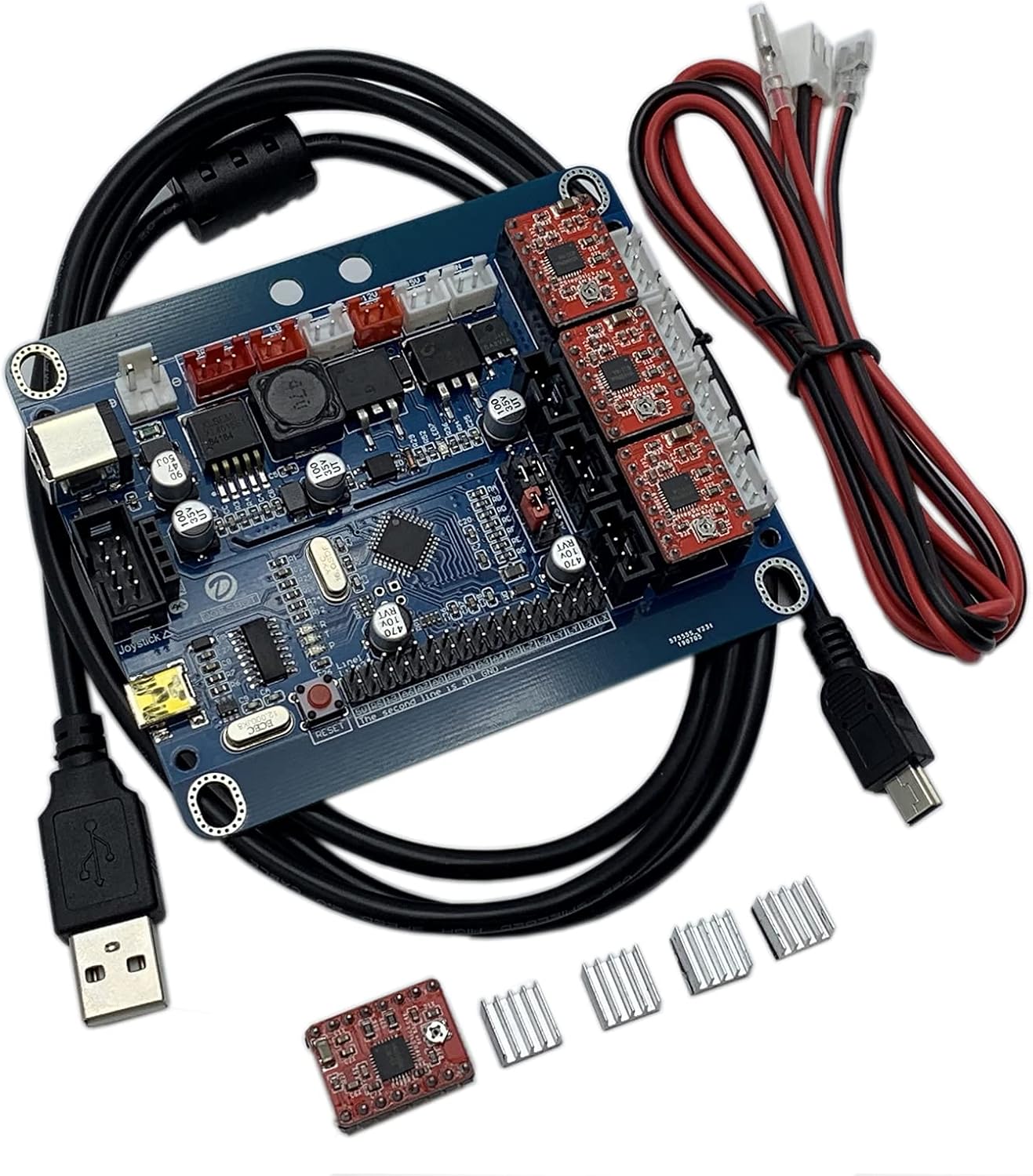
A bare-bones replacement brain for a 3018: an Arduino Nano running GRBL 1.1, three plug-in A4988 stepper drivers, outputs for a spindle or a laser, and inputs for limit switches and a probe.
The Doesbot board is the simplest kind of 3018 controller. An Arduino Nano runs GRBL 1.1 and turns G-code from the USB port into step and direction pulses, and three A4988 driver modules turn those pulses into current for the Nema 17 steppers on X, Y and Z.
Many stock 3018 boards follow the same pattern under their cases. That makes this one a direct stand-in when the original board fails, and a cheap starting point for a machine built from parts.
The board comes bare. There is no case, no fan and no power switch, so it needs mounting on standoffs and, for long jobs, some airflow across the driver heatsinks.
GRBL 1.1 on a Nano is the classic 8-bit setup. It streams at 115200 baud and handles three axes, which is all a 3018 uses. Senders such as Candle, UGS and LaserGRBL connect without drivers beyond the USB-serial chip, as the software entry explains.
| Spec | Value |
|---|---|
| Brand | Doesbot (AOLDHYY) |
| Model | 3AXIS |
| Controller | Arduino Nano based 3-axis motion board |
| Firmware | GRBL 1.1 |
| Connection | USB |
| Board supply | 12–24V DC, polarity sensitive |
| Stepper drivers | 3 × A4988 integrated, for four-wire steppers |
| Driver swap | A4988 can be replaced with DRV8825 |
| Microstepping | Adjustable driver subdivision |
| Axis configuration | XYZ or XYY (dual Y motor) |
| Tool output | Spindle or laser |
| Laser support | 12V and 5V lasers, with or without TTL |
| Inputs | X, Y and Z limit switches; probe |
| Expansion | External offline controller (optional) |
| PCB | 1.6 mm A-plate board |
| In the box | Board, 4 × A4988 drivers (one spare), spindle motor lead, USB cable |
The drivers decide how smoothly and how strongly each axis moves. A4988 modules suit the small Nema 17 motors on a 3018, and the board lets the microstep setting and the current limit be adjusted for each one.
Microstepping splits each 1.8° motor step into smaller moves. The A4988 goes down to one-sixteenth steps, which gives finer motion and quieter running. The DRV8825, which drops into the same sockets, goes to one-thirty-second and handles a little more current.
| Setting | A4988 | DRV8825 |
|---|---|---|
| Finest microstep | 1/16 | 1/32 |
| Current limit | Trim pot on each module | Trim pot on each module |
| Typical 3018 motor | About 1.3A per phase | About 1.3A per phase |
| Heat | Needs a heatsink, better with airflow | Same, runs warm at high current |
Steps per millimetre follow from the lead screw. On a T8 screw with an 8 mm lead, a 200-step motor at 1/16 microstepping needs 400 steps per mm; at 1/32 it needs 800.
Motors that whine and skip usually have too little current; motors that are too hot to touch have too much.
Two features take the board beyond a stock 3018 replacement. It can run two motors on Y, and it can drive small laser modules through either a 12V or a 5V TTL connection.
The XYY setting clones the Y driver's step and direction to a second motor. That suits larger gantry builds where the Y axis has a motor on each side, and it is also how many hobby laser frames drive both sides of a wide bed. A 3018 uses one Y motor, so it stays in the plain XYZ mode.
Laser work on GRBL also needs laser mode switched on. With GRBL setting 32 at 1, the board changes power without stopping at each move, so corners do not burn darker than straight lines.
The probe pin makes Z zeroing quick. A touch plate on the pin and a clip on the bit let the sender lower the tool until contact, then set Z automatically. Limit switches on the three limit inputs make homing possible, which lets the machine find the same origin every session.
The SainSmart Z-axis touch probe is a common partner for that probe input, since it works with Candle's probing routine.


Four boards come up when a 3018 owner needs a new controller. They split by driver type, by the extras packed with each, and by how far beyond basic GRBL they reach.
The Doesbot is the most open of them. It suits someone happy to set jumpers and trim pots, and it doubles as a controller for a plotter or a laser built from scratch. The trade is polish: the Genmitsu board arrives in a case and the MKS with a screen, while this one arrives as a bare circuit board with loose driver modules.
| Board | Drivers | What stands out |
|---|---|---|
| Doesbot GRBL 1.1 | 3 × A4988, socketed | Dual-Y mode, 5V TTL laser, spare driver |
| MYSWEETY GRBL 1.1f | A4988 | 150W spindle output, 3-pin and 2-pin lasers |
| Genmitsu 3018-PRO board | DRV8825 | ABS case, made for the 3018-PRO |
| MKS DLC32 V2 | 32-bit board | Wi-Fi and an LCD touchscreen |
For a Genmitsu 3018-PRO, the Genmitsu board is the plug-for-plug match, with the connectors in the places the looms expect. The Doesbot suits other brands and scratch builds, where a little rewiring is part of the job anyway.
A new board is also the moment to add what the old one lacked. The upgrade order entry puts limit switches and an E-stop early in the list for that reason.
It runs any 3018 with Nema 17 steppers and a small DC spindle. Connectors may differ, so check the plugs and the switch wiring before swapping.
Yes. Doesbot states the A4988 modules can be replaced with DRV8825s, which offer finer microstepping. Set the current limit again after the swap.
It sends the Y signals to a second motor so two Y motors move together. A standard 3018 has one Y motor and uses XYZ.
12V and 5V laser modules, with or without a TTL control input. Turn on GRBL laser mode before engraving.