


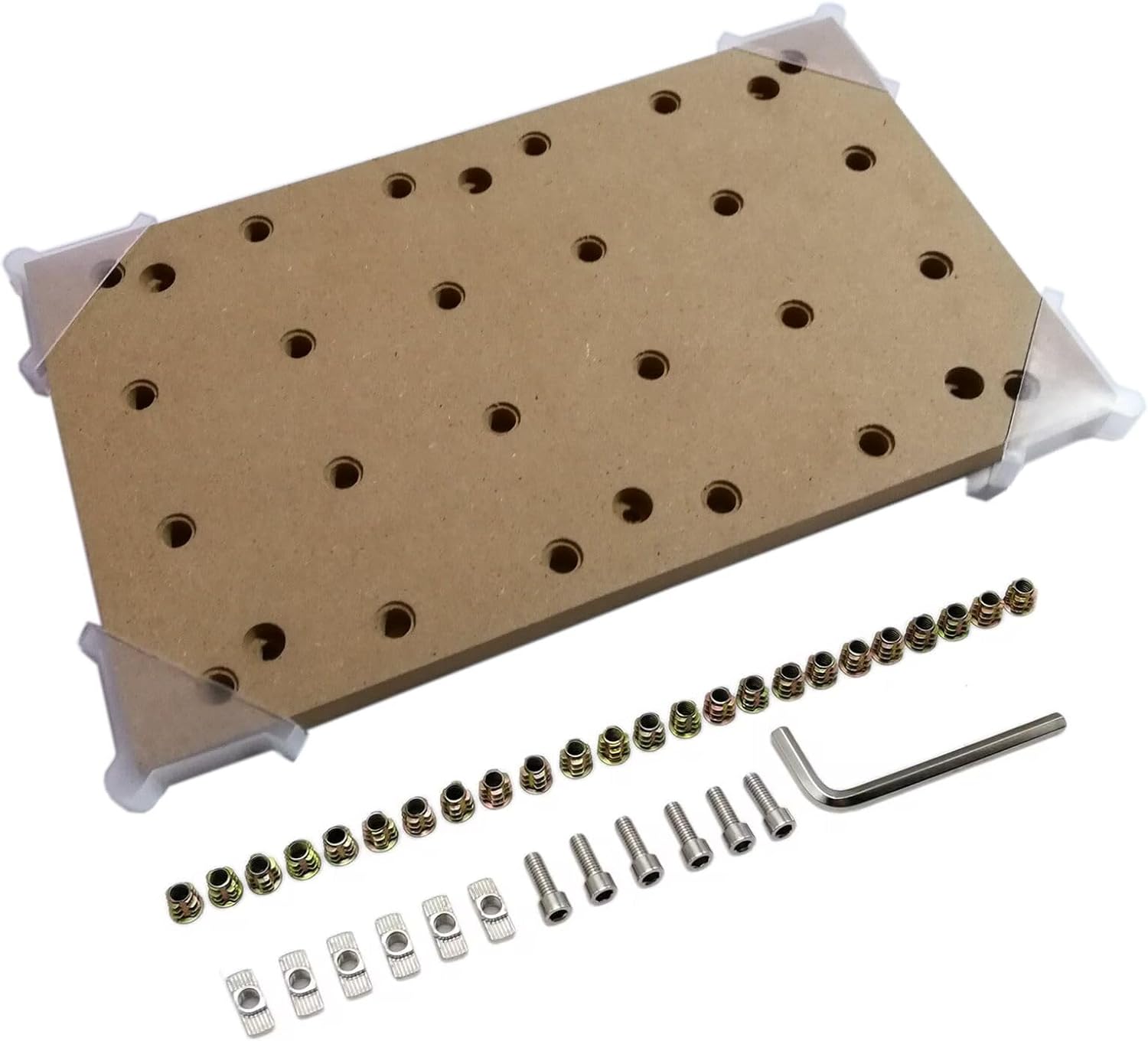
Doesbot 3018 MDF Spoilboard
Doesbot's 300 × 180 × 12 mm MDF board has 24 M6 holes for most 3018 machines.
- Replacement work surface
- Fits most 3018 machines

A 12 mm sheet of MDF cut to the 3018 bed, drilled for M6 clamps and fitted with T-nuts underneath: a flat, cheap surface that takes the cuts so the aluminium bed never does.
The Genmitsu 3018-PRO's bed is a row of 2040 aluminium profiles. It is strong and slotted for clamps, but every through-cut into plywood or acrylic ends with the bit touching it. The SP3018 spoilboard puts 12 mm of MDF on top, so the bit finishes in fibreboard instead of aluminium.
What a spoilboard does for a 3018:
MDF is the classic material for the job. It is dense, uniform and has no grain, so it cuts the same in every direction and surfaces flat. At 300 × 180 mm it matches the 3018 working area, and at 1.1 lb it barely changes the load on the Y axis.
Plywood is the material that makes the case. Cutting a sign out of 6 mm birch means cutting a hair deeper than 6 mm, and that last fraction has to go somewhere. With a spoilboard, it goes into something designed to be cut.
| Spec | Value |
|---|---|
| Model | Genmitsu SP3018 |
| Dimensions | 300 × 180 × 12 mm (11.81 × 7.09 × 0.47 in) |
| Material | MDF (medium-density fibreboard) |
| Clamp holes | 16, M6 (6 mm) |
| Mounting | 6 T-nuts underneath, tightened by hex screws |
| Hardware | Screws and nuts included |
| Weight | 1.1 lb (0.5 kg) |
| Scale grid | None on this version |
| Compatibility | Most 3018 routers, including the Genmitsu 3018-PRO |
| Coolant | Not suitable: MDF swells when wet |
| GRID version | cm scale grid, 24 M6 holes |
| GRID version hardware | 7 × M5 × 16 screws, 7 × M5 slider nuts, 3 mm hex key |
| GRID version weight | 1.3 lb (0.6 kg) |
| GRID version fit | 3018-PRO, 3018-PROVer, PROVer Mach3, 3018-MX3 |
A spoilboard is a consumable. It collects cut lines, screw holes and pocket marks, and it is skimmed flat again once it is too scarred. On a 12 mm board there is room for a good number of passes before a new one is needed.
Take off only what flattening needs. Every millimetre removed shortens the board's life. Mark the date and depth of each surfacing pass on the board's edge in pencil, and it is easy to see how much is left.
| Job | How the spoilboard helps |
|---|---|
| Plywood and MDF cut-outs | The bit finishes in MDF, not aluminium |
| Acrylic panels | Tape and glue hold thin sheet flat |
| PCB isolation milling | A surfaced, flat base for even depth |
| Small parts | Screws into the waste around the part |
| Aluminium sheet | Dry cutting only; no coolant on MDF |
Limits to keep in mind:
Everything needed to fit the board comes with it. Underneath sit six T-nuts on hex screws; they slide into the bed's slots, rotate as the screws tighten, and clamp the board to the profile. No drilling and no new hardware are needed on a 3018-PRO.
A T-nut that has not rotated into its locking position will let one corner lift under cutting load. The corner test in the last step is the quick way to catch it.
Once fitted, surface the board before the first precision job. MDF from the factory is flat, but the bed under it has its own small errors, and surfacing makes the top face square to this spindle on this machine.
Workholding options after fitting:


Genmitsu makes two versions of the 3018 MDF board and sells the plain one with several add-ons. The plain SP3018 has 16 M6 holes and no markings; the GRID version has 24 M6 holes set closer together and a centimetre scale printed on the face.
| Plain SP3018 | GRID board | |
|---|---|---|
| Size | 300 × 180 × 12 mm | 300 × 180 × 12 mm |
| Holes | 16 × M6 | 24 × M6, tighter spacing |
| Scale grid | No | Yes, in centimetres |
| Mounting | 6 T-nuts on hex screws | 7 M5 screws and slider nuts |
| Weight | 1.1 lb | 1.3 lb |
The grid is worth it for anyone placing stock by eye: blanks line up with the printed scale and the denser holes suit small clamps. The plain board is fine for surfacing-heavy use, where the grid would soon be machined away.
Many owners keep a second plain board on the shelf. Swapping a worn board for a fresh one takes minutes with the T-nuts, and the old one can be surfaced at leisure or kept as a dedicated board for through-cuts while the new one stays clean for engraving.
The bundles add one useful extra:
PROVer V2 owners should check before ordering. That machine has a one-piece aluminium spoilboard, and Genmitsu's own notes disagree on whether the grid board fits it. The wider upgrade sequence is on 3018 upgrades, and the 3018-PRO kit can be bundled with this board.
Yes. Its six T-nuts slide into the 3018-PRO's T-slot bed and lock as the hex screws tighten.
12 mm (about 1/2 in), in a 300 × 180 mm sheet to match the 3018 working area.
No. MDF swells when wet, so avoid spray or mist coolant and oils; cut dry.
The GRID version has 24 M6 holes instead of 16 and a centimetre scale printed on the surface.
Once after fitting, then whenever cuts and screw holes leave it uneven. Take off only a few tenths of a millimetre each time.