- 300 × 180 × 40 mm
- 775 brushed spindle, ER11 collet
- All-metal frame
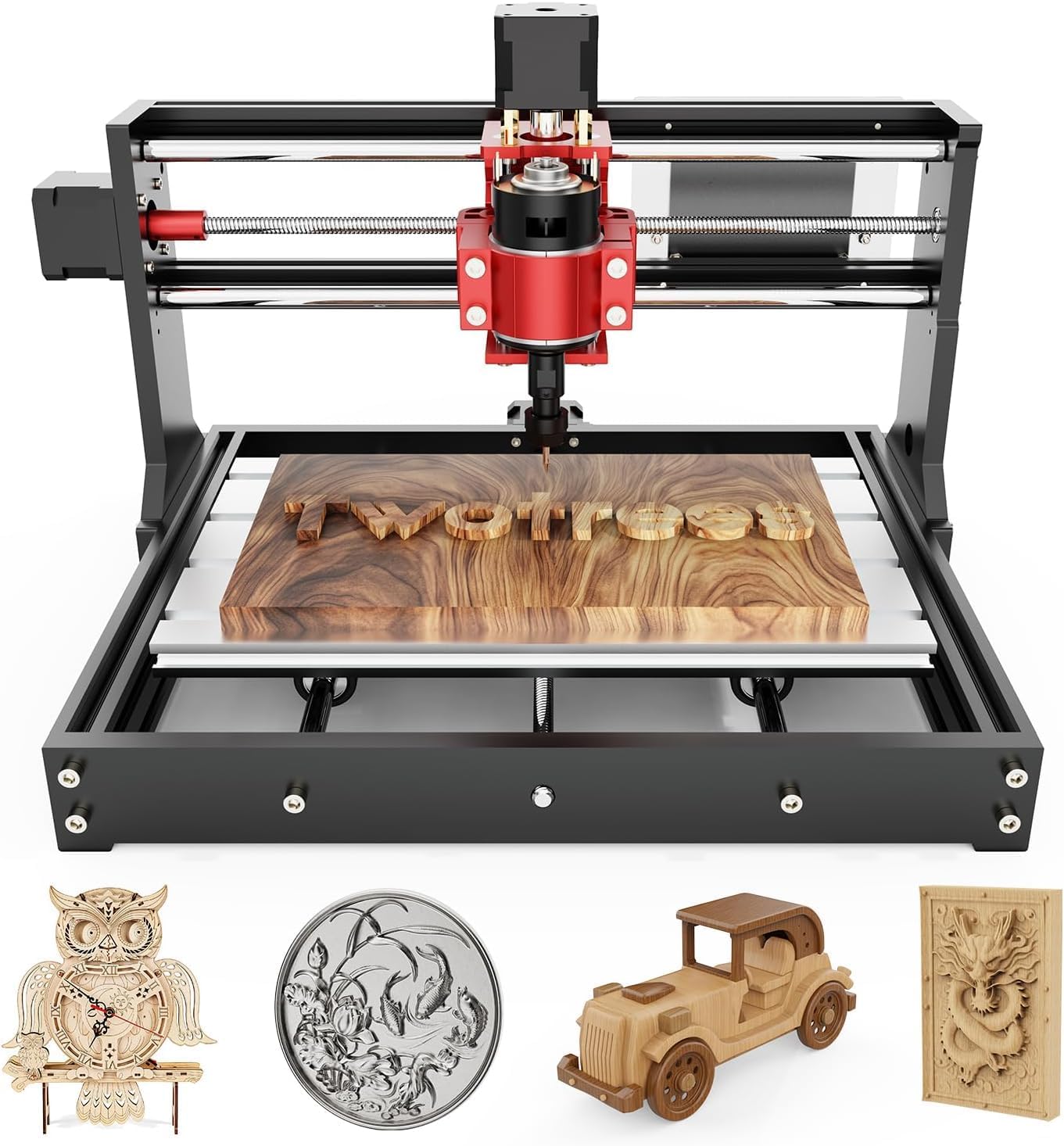
The desktop router most people mean when they say 3018: a 300 × 180 mm T-slot bed, a 24V 775 spindle on a nylon Z carriage, GRBL on the board and a handheld controller for runs without a laptop.
Genmitsu's 3018-PRO is the reference build of the whole 3018 family: the same 300 × 180 mm footprint the clones copy, with the assembly tidied up. The components drop into place without aligning, and the base is raised to 4 cm so the frame sits stiffer on the bench. What arrives is a hobby router sized for signs, coasters, PCB blanks and small parts.
Three things set this kit apart from a generic 3018:
The motion system is plain and easy to service: linear shafts carry each axis and leadscrews drive them, with a top travel speed of 1200 mm/min. The bed is a T-slot 2040 aluminium profile, so clamps and a sacrificial board bolt straight on.
Birch plywood is the classic first material. A 20° V-bit from the kit engraves lettering, and a 1/8 in flat end mill cuts letters or pockets in shallow passes. Soft maple and walnut follow the same rules at a slower feed.
Plywood also shows the frame's limits early. Glue lines in cheap sheet dull bits fast, and voids in the core chip out at the letter edges, so a few sheets of good birch are worth more than a new cutter.
| Spec | Value |
|---|---|
| Model | Genmitsu 3018-PRO |
| Working area (X × Y × Z) | 300 × 180 × 45 mm (11.8 × 7.1 × 1.8 in) |
| Machine footprint | 400 × 330 × 240 mm (15.7 × 13.0 × 9.4 in) |
| Frame | PF plates on aluminium profile, base raised to 4 cm |
| Bed | T-slot 2040 aluminium profile |
| Motion system | Linear shafts and leadscrews |
| Maximum travel speed | 1200 mm/min |
| Z-axis carriage | Nylon |
| Spindle | 775 DC motor, 24V |
| Spindle power | 60W rated, 120W maximum |
| Stepper motors | 1.3 A, 0.25 N·m holding torque |
| Included bits | 20° V-bits, 0.1 mm tip, 3.175 mm (1/8 in) shank |
| Controller | GRBL board in an ABS case with fan |
| Offline control | Handheld offline controller included |
| Sender software | Candle (GRBL control) |
| Supported OS | Windows XP, 7, 8, 10 and macOS |
| Power supply | 24V, 4A |
| Weight | 15.3 lb (6.9 kg) |
The 775 motor sets the pace for every material on this machine. It has enough torque for a 1/8 in cutter taking shallow passes, and it runs out of stiffness long before it runs out of speed. Keep the depth of cut small and let the passes add up.
| Material | Good on a stock 3018-PRO | Starting approach |
|---|---|---|
| Softwood, plywood, MDF | Signs, coasters, pockets, cut-outs | 1/8 in two-flute, 0.5–1 mm per pass |
| Hardwood | Lettering, inlays, small boxes | Same bit, shallower passes, slower feed |
| Cast acrylic | Engraved plates, cut-out shapes | Single-flute O-flute, 0.3–0.5 mm per pass |
| FR4 / copper clad | Isolation-milled prototype boards | 20° V-bit, a levelled bed, very shallow cut |
| Aluminium | Engraved tags, thin plate only | Single-flute, 0.1–0.2 mm per pass, patience |
Those depths are common starting points, not fixed numbers. The right feed depends on the bit's sharpness and flute count, how far the collet hangs below the carriage, and how firmly the blank is fixed.
Signs that a cut is asking too much of the frame:
Every one of those fixes the same way: slow the feed, shallow the pass, sharpen or swap the bit. The starter feeds and first cuts go through wood, acrylic and PCB material in more detail.
The kit ships as a set of assemblies rather than a pile of loose parts. The frame, the gantry and the Z carriage go together with the included hex keys, and the cables plug into a labelled board. Most first builds end in the same place: the spindle homed over a scrap of pine, Candle open, and a first test file ready.
The board stores GRBL's configuration. The values worth reading on day one are the steps-per-mm figures, the maximum rates and the maximum spindle value, which decides what the S number in a G-code file means. The software walkthrough covers Candle, UGS and the settings that trip people up.
The offline controller takes over once a file is proven:
There are no limit switches in this kit. Homing is manual, and the machine trusts the zero you set, so mark the origin on the spoilboard for repeat jobs.
Every box holds the same machine; the bundles differ in the one extra part that comes with it. Pick by the job the router will do most in its first month, because every add-on here also exists on its own for later.
Against the other popular frames, the choice is about the Z axis and safety kit:
| Machine | Pick it when |
|---|---|
| 3018-PRO | Wood and plastic first, offline control wanted, most parts available |
| TTC3018 Pro | A metal Z and T8 screw from day one for thin brass and aluminium sheet |
| 3018-PROVer V2 | Limit switches, an E-stop and a probe included, pre-assembled gantry |
Three questions settle the order: is there bench room for a 400 × 330 mm frame plus cables, is there a stock of 1/8 in bits, and is soft metal a real plan? If it is, budget for the aluminium Z assembly now. Other 3018-PRO builds from other makers are compared on the 3018 Pro CNC machine page.
In thin passes, soft aluminium is possible; Genmitsu describes it as an engraving and light-duty machine, not a metal mill. The aluminium Z assembly and a larger spindle make soft metal far more practical.
Not for every job. The included offline controller runs G-code from its memory card; a computer still makes the files and handles Candle-based setup.
No. Zero is set by hand for each job. Limit switches and an E-stop come standard on the 3018-PROVer V2.
Any GRBL sender, with Candle as the standard choice on Windows. Designs come from CAM software such as Carveco, Easel or Fusion 360.
300 × 180 × 45 mm, on a frame roughly 400 × 330 × 240 mm.