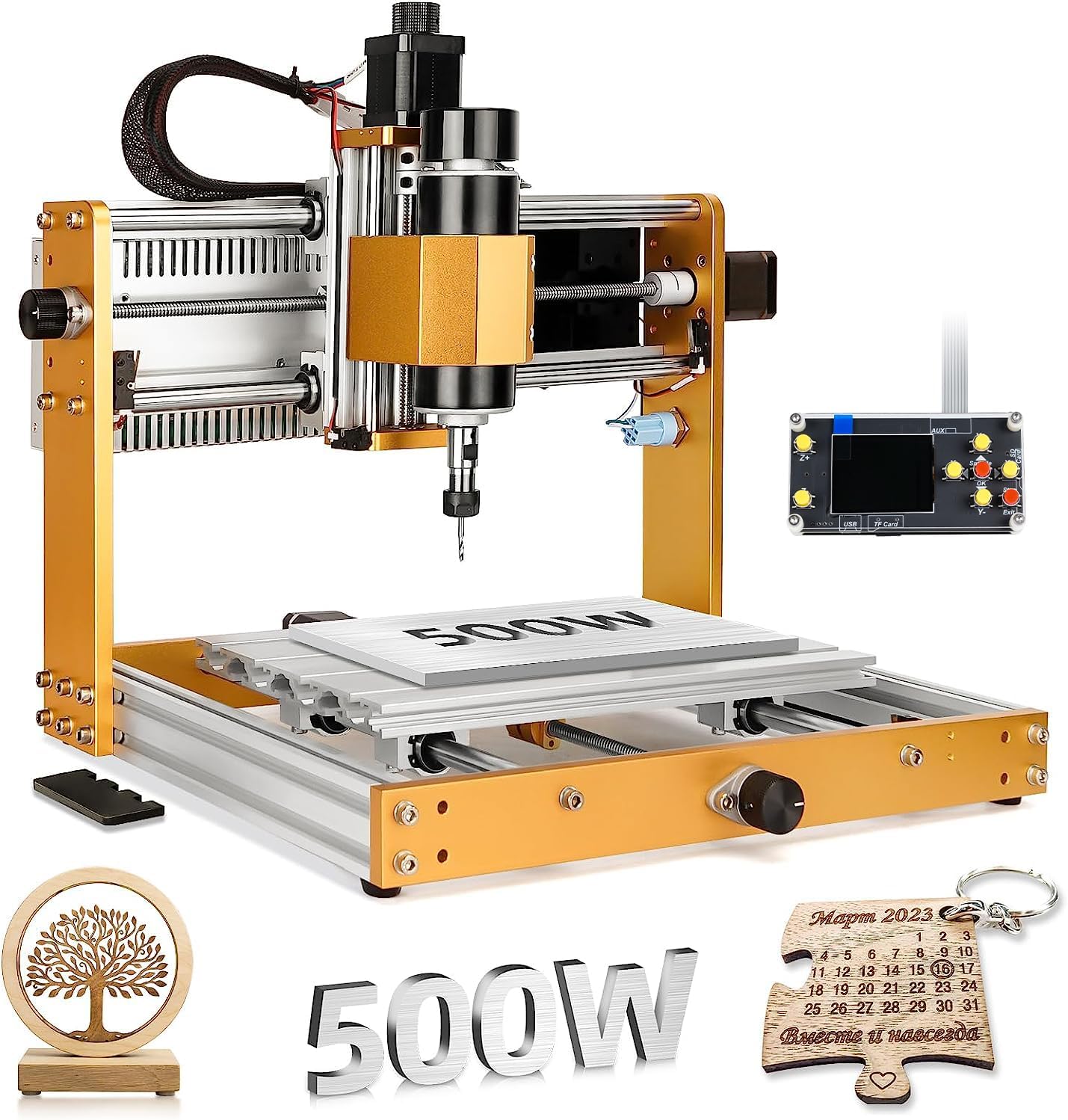
- 300 × 180 × 80 mm
- 500W spindle motor
- All-metal frame
A 3018-size router built heavier: a 500W, 48V spindle, 78 mm of Z travel and an 11.5 kg aluminium frame, run by an ESP32 board with six limit switches, an E-stop and a tool setter.
The Ascarva 3S keeps the 3018 footprint of 300 by 180 millimetres and changes nearly everything else. A 500W DC spindle on 48V replaces the usual 775 motor. The frame is reinforced aluminium panels and extrusions, weighing 11.5 kg, and Z travel reaches 78 mm.
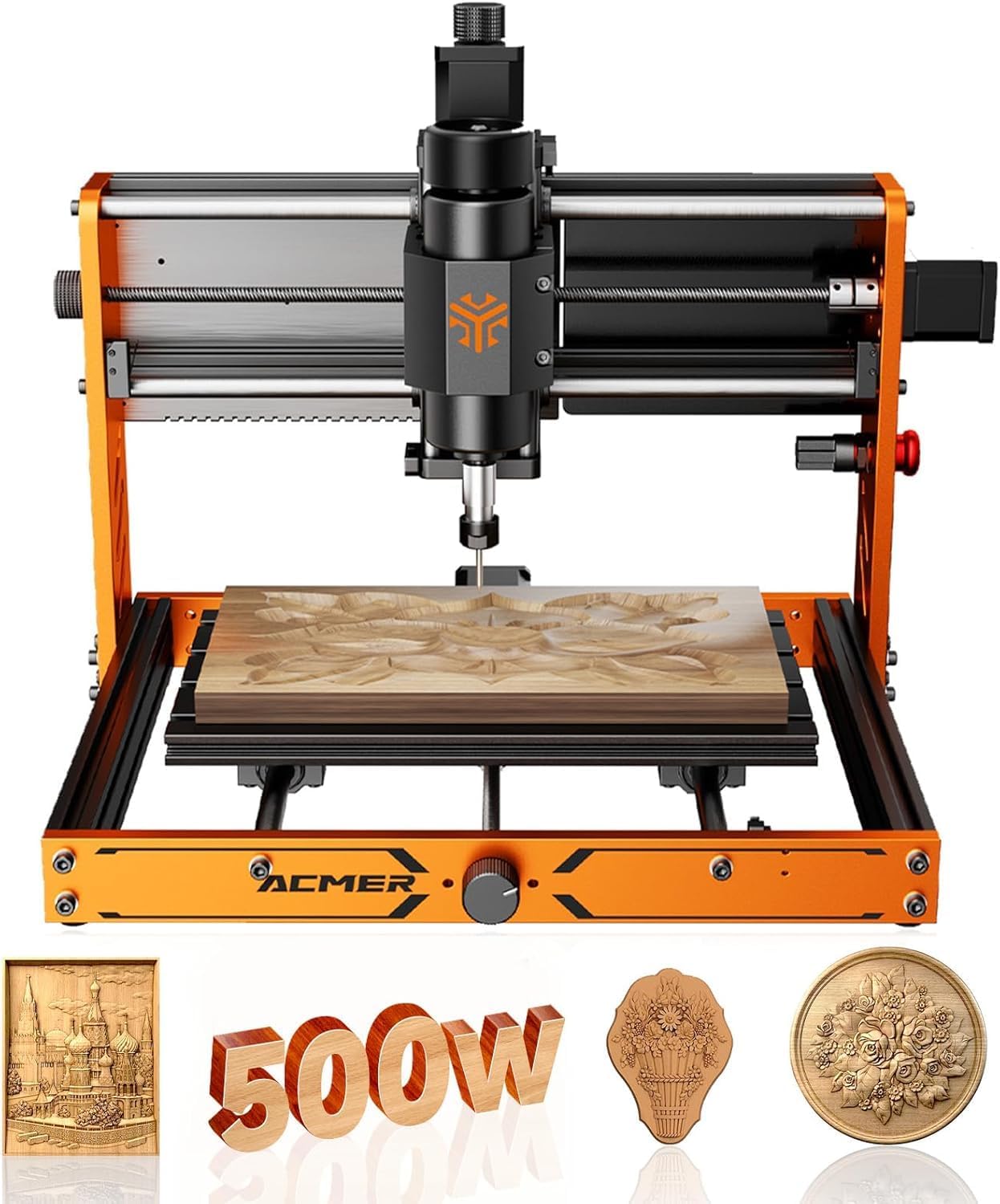
ACMER names wood, plastic, acrylic, MDF, nylon and soft metals as its materials, and supplies a parameter table for RenShape, plywood, acrylic and PC board. RenShape, a machinable tooling board, is a telling entry: it is what product designers carve to prototype shapes, and it rewards a stiff machine with a steady spindle.
Frame weight matters just as much. An 11.5 kg machine resists chatter better than a light moulded frame, and ACMER quotes ±0.025 mm repeat positioning. That figure describes returning to the same point, not the finish on an aluminium pocket, which still depends on the bit, depth of cut and holding.
For a sense of feeds in each material, the materials and first cuts entry sets out starting points across the 3018 class.
| Spec | Value |
|---|---|
| Model | ACMER Ascarva 3S |
| Working area | 300 × 180 × 78 mm (11.81 × 7.09 × 3.07 in) |
| Spindle | 500W DC spindle, 48V |
| Maximum spindle speed | 12,000 rpm |
| Spindle power | 0.67 hp |
| Collet | ER11 |
| Repeat positioning accuracy | ±0.025 mm |
| Frame | Reinforced aluminium alloy panels and extrusions, modular |
| Net weight | 11.5 kg (25.4 lb) |
| Mainboard | ESP32 |
| Connection | USB |
| Computer systems | Windows, macOS, Linux |
| Software | Candle, UGS, Easel |
| File formats | .nc, .gcode |
| Interface languages | English, Chinese, Spanish, German, French and more |
| Safety | Emergency stop button, six limit switches |
| Included extras | Tool setter; parameter table for RenShape, plywood, acrylic and PC board |
| Expansion | Modular; can be built up into a wood router setup |
Most basic 3018 frames offer 40 to 45 mm of Z. The Ascarva 3S nearly doubles that to 78 mm, and the difference changes which jobs fit under the spindle. It is the working-area figure that matters most after the spindle.
What the extra depth makes room for:
The spindle itself is a 48V DC motor rated 500W, or 0.67 hp, with an ER11 collet and a top speed of 12,000 rpm. That is slower at the top than a 20,000 rpm 775, but with far more torque. Larger bits suit it better than tiny ones: a 1/8 in or 1/4 in end mill can take a real chip, while 0.1 mm PCB V-bits prefer higher rpm.
| Job | Bit | Why the 3S suits it |
|---|---|---|
| Aluminium plate | Single-flute 1/8 in | Torque holds rpm in the cut |
| Maple relief | Ball-nose, long reach | 78 mm of Z for thick blanks |
| Acrylic panels | Single-flute | Stiff frame for clean edges |
Long bits and deep blanks still flex a small gantry. Take depth in several passes, and keep bit stick-out as short as the job allows.
The Ascarva 3S arrives with the safety and setup parts that most budget 3018s leave out. An emergency stop button, six limit switches and a dedicated tool setter come in the box. An ESP32 mainboard runs it over USB from Windows, macOS or Linux.
The modular frame goes together from aluminium panels and extrusions. A sensible first session looks like this:
Six limit switches mean both ends of every axis are guarded. A job that runs past the edge, or a jog pressed too long, stops at the switch instead of grinding a motor against the frame.
The modular build has a practical upside later. Panels and extrusions come apart for maintenance, and ACMER describes the system as expandable into a larger wood router setup, so the machine can grow instead of being replaced.
Sender settings and the Mac and Linux options are in 3018 CNC software.
The 500W class of 3018-size routers is small, and three machines frame it well. They share a 300 × 180 mm bed and a 500W spindle topping out at 12,000 rpm. The differences are in Z travel, controls and power layout.
| Machine | Z travel | Control | Stands out for |
|---|---|---|---|
| ACMER Ascarva 3S | 78 mm | ESP32 board over USB | Tool setter, Mac/Linux support, parameter table |
| LUNYEE 3018 Pro Max | 80 mm | GRBL with offline controller | 12 mm rods, handwheels, runs without a PC |
| WolfPawn 3018 500W | 60 mm | E-stop and limit switches | Integrated power supply chassis |
The 3S is the pick when:
A LUNYEE is the better fit when:
Before choosing any of the three, check the bench. An 11.5 kg frame plus a 500W spindle wants a solid table, and the spindle's noise and chips call for a room where both are welcome. A dust shoe and a vacuum come sooner on these machines than on a 775 frame, because a 500W spindle with a 1/4 in bit moves a lot more material per minute.
All three sit well above a basic 3018 on the price bands. For a wider look at the 500W frames, see 3018 Pro Max machines.
300 × 180 × 78 mm (11.81 × 7.09 × 3.07 in): a standard 3018 bed with almost double the usual Z travel.
Yes. It connects over USB to Windows, macOS or Linux and supports Candle, UGS and Easel.
Soft aluminium and brass, yes, in light passes. The 500W spindle and 11.5 kg frame make it more capable in soft metal than 775-based 3018s.
ACMER does not list one. The machine is described as running over USB from a computer through its ESP32 board.
An emergency stop button, six limit switches and a tool setter for Z zero.