
Genmitsu 3018 MDF Spoilboard
Genmitsu's 30 × 18 × 1.2 cm MDF spoilboard for the 3018-PRO, with M6 holes and screws and nuts included.
- Replacement work surface
- Fits 3018-PRO
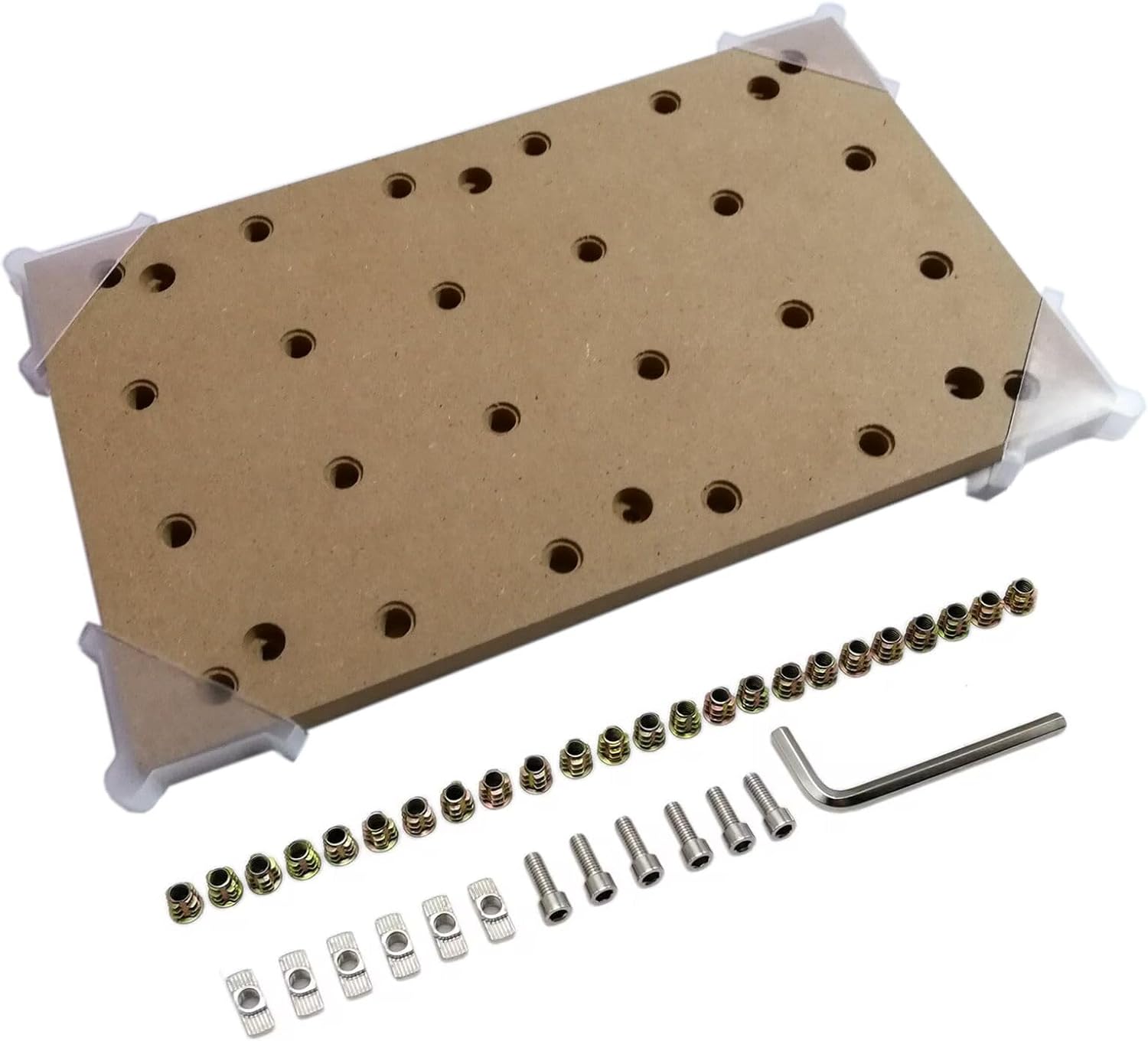
A sacrificial MDF board the size of a 3018 bed, drilled with 24 M6 holes for clamps, that takes the bit at the end of every through-cut so the aluminium table underneath never does.
The aluminium table on a 3018 is part of the machine, not a cutting surface. Every through-cut ends with the bit a fraction of a millimetre below the stock, and without a spoilboard that fraction lands in the table. The Doesbot board puts 12 mm of MDF in the way.
It is sized to the machine rather than cut from a sheet:
MDF suits the job for plain reasons. It is uniform all the way through, with no grain to tear or knots to deflect a bit. It machines flat with a wide cutter. And it is cheap enough to replace when it is finally too scarred or thin.
Plywood and hardboard are sometimes used instead. Plywood voids and glue lines make surfacing uneven, and hardboard is thin, so a purpose-cut MDF board with its holes already placed saves both the sawing and the drilling.
A spoilboard is among the first three parts most 3018 owners add, alongside a probe and better clamps, as set out in 3018 upgrades.
| Spec | Value |
|---|---|
| Model | mdf3018-2 |
| Material | MDF (medium-density fibreboard) |
| Length × width | 300 × 180 mm (11.81 × 7.09 in) |
| Thickness | 12 mm (0.47 in) |
| Holes | 24 |
| Hole size | M6 × 1 |
| Table fit | 15180 aluminium profile worktables, 300 mm long |
| Machine fit | Most 3018 CNC routers |
| Purpose | Sacrificial surface for non-metallic cutting; protects the aluminium table |
| Liquids | No lubricants, coolant or oil; MDF swells with moisture |
| In the box | MDF spoilboard, screws |
| Weight | 1.65 lb |
| Package size | 33 × 23 × 2 cm |
| Package weight | 0.75 kg |
Cutting a part free is where a spoilboard earns its place. The toolpath goes a little deeper than the stock is thick, the bit clears the bottom face cleanly, and the extra depth disappears into MDF rather than aluminium. Everything from coasters to acrylic letters depends on it.
| Stock | Cut past the bottom by | Hold-down |
|---|---|---|
| 3 mm birch plywood | 0.2–0.3 mm | Clamps in the M6 holes, plus tabs |
| 6 mm MDF | 0.2–0.3 mm | Clamps, or double-sided tape |
| 3 mm cast acrylic | 0.2 mm | Tape across the whole sheet, tabs |
| 1.6 mm FR4 PCB | 0.1–0.2 mm | Tape on a freshly surfaced area |
Three ways to hold stock on the board:
Tabs matter as much as depth. Leave three or four small bridges on each part so it cannot spin free and meet the bit on the last pass. Cut the final pass at the same feed as the rest; slowing down in the spoilboard only burns the MDF and dulls the bit. Material starting points for these cuts are in what a 3018 cuts.
A new spoilboard is flat, but the gantry may not travel parallel to it. Surfacing fixes that: the machine skims the top of the board with a wide flat bit, and the fresh surface is then exactly parallel to the spindle's travel. Do it once at fitting and again whenever the board is scarred.
Points to watch:
Surfacing toolpaths are easy to make in Easel or Carveco, covered in 3018 CNC software.


Several spoilboards fit a 3018, and they differ in thickness, hole pattern and the frame they target. The Doesbot board is the plain full-size MDF option for standard 15180 tables. The others suit particular machines or a larger bed.
| Spoilboard | Size | Holes | Best for |
|---|---|---|---|
| Doesbot MDF | 300 × 180 × 12 mm | 24 × M6 | Standard 3018 tables of 15180 profile |
| Genmitsu MDF | 30 × 18 × 1.2 cm | M6, screws and nuts | Genmitsu 3018-PRO |
| LUNYEE grid MDF | 300 × 180 × 12 mm | 24, printed cm grid | LUNYEE Pro Max and Pro Ultra |
| Genmitsu 3040 T-slot aluminium | Extends to 3040 | 4 T-slots per side | A 3018-PRO with the Y extension kit |
Pick the Doesbot board if:
Pick the LUNYEE board for a LUNYEE frame, where its hole spacing is designed to match, or when a printed grid would help place blanks. Pick an aluminium T-slot bed when the plan includes a bed extension and heavier workholding.
Whichever board goes on, treat it as a consumable. After many resurfacings, when the holes run shallow or the board goes thin, replacing it costs less than one ruined blank.
A spare board on the shelf also opens a useful trick: keep one surfaced board for tape-held acrylic and PCB work, where flatness is everything, and a second for screwed-down plywood jobs, where holes and scars do not matter. Swapping them takes the few minutes needed to undo the fixing screws.
The first surfacing pass on any new board is also the best time to check tram and gantry square, before a real project depends on them.
It is made for 3018 tables of 15180 aluminium profile, 300 mm long, which covers most 3018 frames. Check the fixing points on other tables.
The board has 24 holes for M6 × 1 screws, spread for clamps and hold-downs.
No. MDF swells with moisture; Doesbot advises against lubricants, coolant and oil.
Yes. It raises the work surface by 12 mm, which on a 45 mm-Z machine leaves less room for thick stock and long bits.
Only as deep as the scars, typically 0.2–0.5 mm, with a wide flat bit and 40–50% stepover.