
Genmitsu 3018 MDF Spoilboard
Genmitsu's SP3018 board is 30 × 18 × 1.2 cm MDF with M6 holes, screws and nuts for the 3018-PRO.
- Replacement work surface
- Fits 3018-PRO

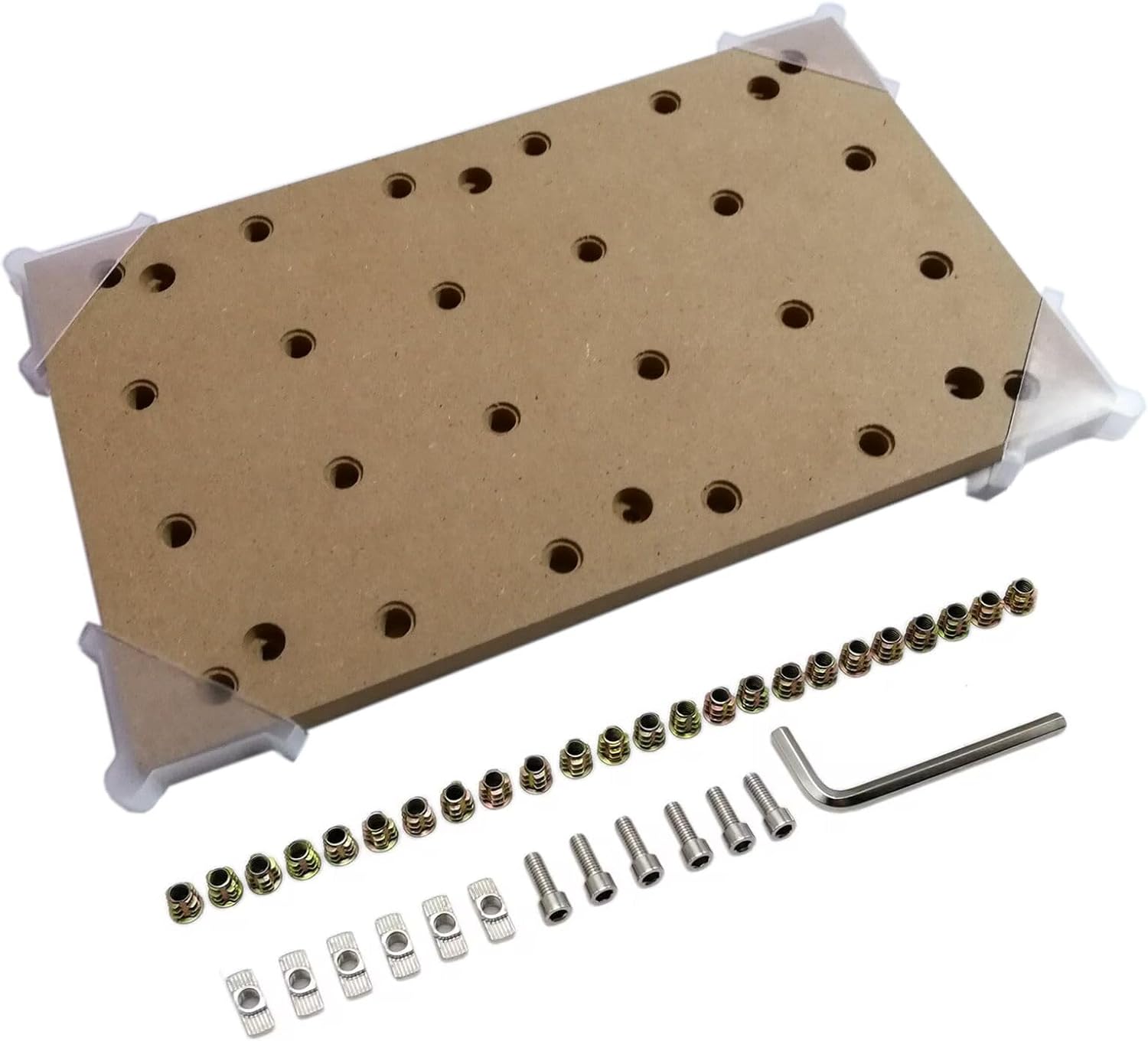
A sacrificial MDF board with a printed centimetre grid and 24 M6 holes, made to sit on the LUNYEE 3018 Pro Max and Pro Ultra beds and take the through-cuts their aluminium tables should not.
The LUNYEE Pro Max and Pro Ultra come with metal work tables, and a bit that finishes a through-cut goes straight into them. This 12 mm MDF board sits on top as the surface the bit is allowed to scar, and it gets replaced when it wears out.
LUNYEE sized it for its own two 500W machines, and three details set it apart from a plain offcut of MDF:
The Pro Max uses a T-slot style bed, while the Pro Ultra has a one-piece machined aluminium plate with its own scale. Either one is expensive to replace and slow to re-flatten. A board that costs a fraction of that takes the damage instead.
MDF suits the job because it is even all the way through. There is no grain to tear out, no knots and no voids, so a surfacing pass leaves a uniform face. It is also soft enough that a stray plunge only marks the board and the bit survives.
| Spec | Value |
|---|---|
| Brand | LUNYEE |
| Model | MDF3018 |
| Part number | MDB-180*300*12TJ |
| Material | Medium-density fibreboard (engineered wood) |
| Board size | 300 × 180 × 12 mm |
| Thickness | 12 mm (0.47 in) |
| Clamp holes | 24, M6 (6 mm) |
| Hole spacing | Under 54 mm between neighbouring holes |
| Surface marking | Scale grid printed in centimetres |
| Mounting hardware | Screws included, two accessory sets for different worktops |
| Compatible machines | LUNYEE 3018 Pro Max, LUNYEE 3018 Pro Ultra |
| Other 3018 frames | Check the mounting-hole spacing first |
| Weight | 1.3 lb (about 0.6 kg) |
| In the box | 1 CNC MDF grid spoilboard |
A new spoilboard is flat, but not necessarily parallel to the path the spindle travels. On a 3018-sized frame a few tenths of a millimetre of tilt is enough to leave one corner of a walnut coaster thicker than the other.
The cure is a surfacing pass: skim the whole board with a wide flat bit so its face matches the gantry exactly. On a 500W spindle a 1/4-inch or wider flat bit works, cutting 0.2 to 0.3 mm deep with generous stepover.
There is a trade-off here. The printed grid lives on the surface, and a full surfacing pass removes it. Two approaches keep both benefits:
For the coasters themselves, a through-cut should go 0.2 to 0.5 mm into the board so the last skin of walnut parts cleanly. Small tabs hold each disc in place until the job finishes, and a light sanding removes them afterwards. The board takes those shallow grooves job after job before it needs another skim.
Close hole spacing is the board's quiet advantage. On a 300 × 180 mm bed, stock is often small, and a clamp sitting 80 mm away from a 60 mm blank cannot reach it.
With neighbours under 54 mm apart, there is almost always a hole within reach of any edge. That makes small side clamps practical, and LUNYEE makes two that suit its own machines: tiger claw side clamps with serrated faces, and mini hold-down clamps for stock up to 1.77 inches thick.
How to hold three common materials:
MDF does have one weakness. Water, oil and coolant soak into the fibres and swell the board, so any aluminium work should run dry or with an air blast. A few drops of lubricant on the bit are fine; puddles are not.
The M6 holes also take jigs. A plywood fence screwed into two holes gives a square corner for batch work, like a run of identical name tags, and it comes off in a minute when the job ends.
Worn threads are the usual end of an MDF board. M6 screws driven straight into fibreboard strip if they are tightened hard or swapped in and out every day. Snug is enough; if a hole goes soft, move the clamp to its neighbour, which on this grid is never far away.

Several boards claim to fit a 3018, and a vacuum table fits the Pro Ultra too. The right choice depends on the frame under it and what gets cut on top.
| Option | Made for | Holds work by |
|---|---|---|
| LUNYEE MDF board | LUNYEE Pro Max, Pro Ultra | 24 M6 holes and clamps |
| Genmitsu SP3018 MDF board | 3018-PRO and most 3018 kits | M6 holes and clamps |
| Doesbot MDF board | 15180 aluminium profile tables | 24 M6 holes and clamps |
| Fafeicy vacuum table | Pro Ultra, Pro Max T-slot bed | Suction from a built-in pump |
Pick the LUNYEE board if you own one of its two machines and want the mounting to line up without drilling. Pick a Genmitsu or Doesbot board if the frame is a Genmitsu 3018-PRO or a generic open-frame kit. The vacuum table is a different tool: no clamps at all, good for thin sheet, but it cannot take through-cuts the way sacrificial MDF can.
Three measurements settle the fit:
Cost per scar also counts for it. A board this size is cheap enough to treat as a consumable, and once it is thin from repeated surfacing, a new one drops into the same holes.
For the machines themselves, see the Pro Ultra logbook and the Pro Max comparison.
LUNYEE built it for its 3018 Pro Max and Pro Ultra. On any other frame, check the mounting-hole spacing before ordering.
Twenty-four M6 holes, with no two neighbouring holes more than 54 mm apart.
Yes. The grid is printed on the face, so a full surfacing pass takes it off. Surface only the working area if you want to keep the scale.
Avoid it. Water, oil and coolant swell MDF, so aluminium cuts on it should run dry or with air.