- Control electronics
- Fits 3018-PROVer V2, 3018-PROVer, 3018-MX3
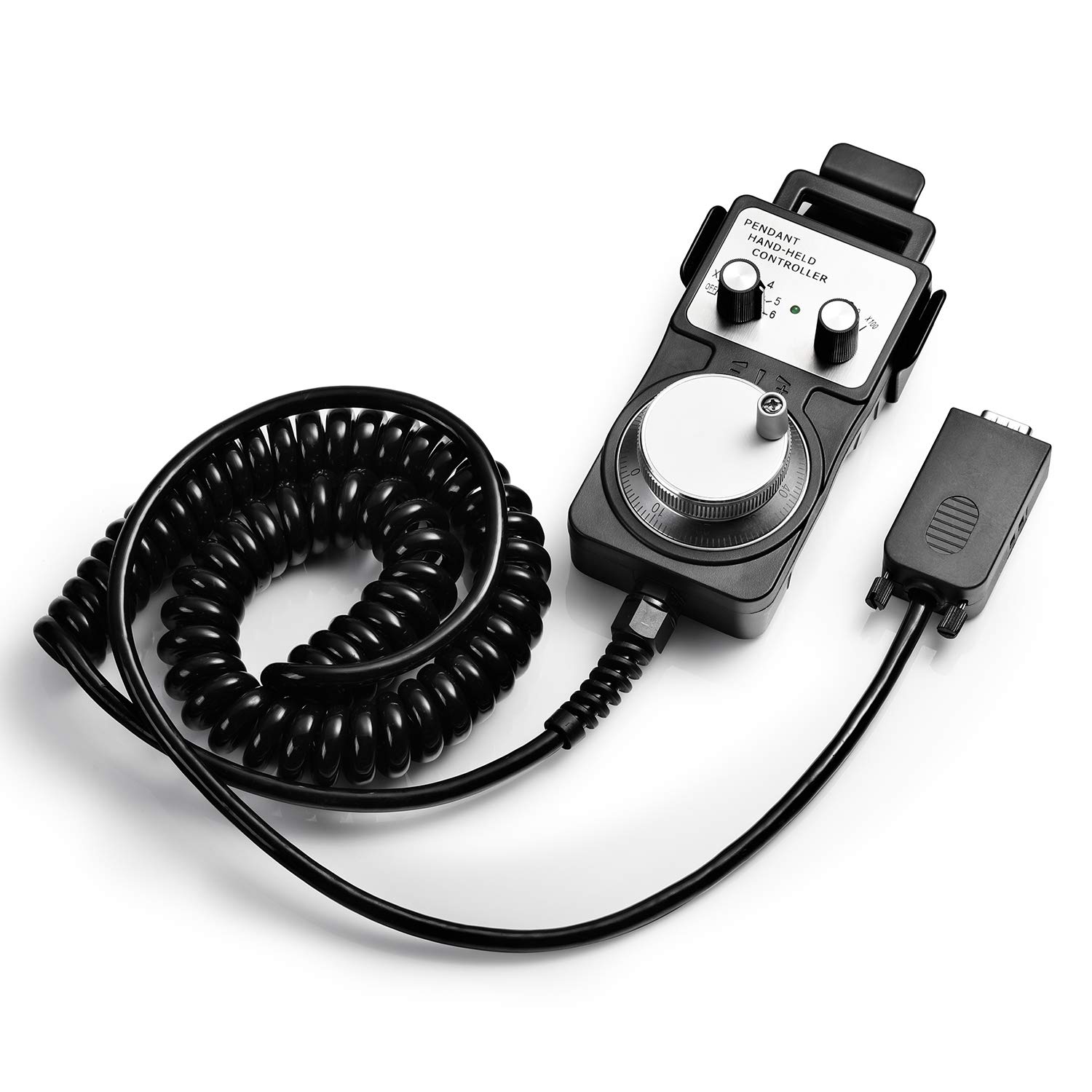
A manual pulse generator pendant with a metal 100PPR handwheel and x1, x10 and x100 steps, sold for the Genmitsu 3018-PROVer and 3018-MX3. It moves X, Y and Z by hand, the way a machinist sets up on a mill.
Jog buttons move a 3018 in jumps. A handwheel moves it the way a manual mill moves: turn slowly and the axis creeps, turn fast and it travels, stop turning and it stops exactly where your hand did.
This pendant brings that feel to the Genmitsu 3018-PROVer and 3018-MX3. It is a manual pulse generator, or MPG: a metal wheel on a 100 pulse-per-revolution encoder, with a selector for the axis and another for the step size. Each click of the wheel sends pulses to the controller board, and the board moves the chosen axis to match.
What it does on the bench:
The pendant is about 135 by 69.5 mm, small enough to hold in one hand while watching the bit with your eyes a few centimetres from the stock.
It does one job only. It positions the machine for setup, touch-offs and inspection, and it does not store or run G-code. Jobs still come from the computer, or from an offline controller on machines that have one.
| Spec | Value |
|---|---|
| Type | MPG handwheel pendant (manual pulse generator) |
| Axes controlled | X, Y, Z |
| Handwheel | Metal |
| Encoder | 100 PPR |
| Step ranges | x1, x10, x100 |
| Jog speed | Follows how fast the wheel is turned |
| Output circuit | Open collector, complementary, long-line types listed |
| Resolution, as printed | 25 / 100 |
| Driver | None needed |
| Connection | Plugs into the machine's controller board |
| Compatible machines | Genmitsu 3018-PROVer, 3018-MX3 |
| Pendant size | About 135 × 69.5 mm |
| Package size | 11.81 × 7.87 × 3.94 in |
| In the box | 1 MPG handwheel controller set |
Most 3018 jobs zero on the corner of the stock, and a jog button gets close enough. The handwheel earns its place on jobs that start from a feature: the edge of a board already cut, the centre of a hole or the surface of a thin PCB blank.
The three ranges work like gears on a manual mill:
| Range | Use it for |
|---|---|
| x100 | Crossing the bed, parking the gantry |
| x10 | Approaching the stock, rough alignment |
| x1 | The final approach to an edge or surface |
Touching off on the edge of a walnut board, for a job that has to line up with an existing cut:
On a PCB blank the handwheel helps with Z. Isolation milling works to depths of a tenth of a millimetre or less, and creeping down at x1 onto the copper, watching for the first scratch, gives a precise zero where a probe is not available.
Centring on a hole works the same way. Touch off on the left and right walls at x1, note both X positions, and move to the midpoint; repeat on Y. It is slower than a probe routine, but it needs nothing beyond the pendant and a steady hand.
The pendant connects to the controller board, not to the computer. That is why it needs no driver, and also why it only works on boards built for it.
The PROVer and MX3 named in its model list are the boards it is sold to plug into. First, look at your board for a port intended for a handwheel or MPG, and check the manual that came with the machine.
First power-up, step by step:
The listed output types, open collector, complementary and long-line, describe how the encoder signals the board. They matter only if you are wiring the pendant into a board other than the PROVer's. For the named machines, it is a plug-in part.
Care for a handheld pendant is mostly about the cable:
A handwheel pairs well with a touch probe. The wheel places the bit precisely in X and Y, and the probe sets Z, so each part of setup uses the tool that suits it.
The same pendant is sold under a long list of brand names, with identical titles and identical descriptions. That description closely matches Genmitsu's own MPG handwheel, but the model list is shorter.
| Feature | MPG pendant (this one) | Genmitsu MPG handwheel |
|---|---|---|
| Wheel | Metal, 100PPR | Metal, 100PPR |
| Steps | x1, x10, x100 | x1, x10, x100 |
| Driver | None | None |
| Models listed | 3018-PROVer, 3018-MX3 | 3018-PROVer V2, PROVer Mach3, MX3, 3020-PRO MAX V2, 4040-PRO, 4040 Reno |
| Warranty | Not stated | One year, lifetime support |
Choose Genmitsu's own handwheel if:
Choose this pendant if the machine is an original 3018-PROVer or a 3018-MX3 and you are comfortable with an unbranded part. Whichever badge it carries, the pendant is the same unit, with the same wheel, selectors and cable.
The model list is the deciding line. On an original PROVer or MX3, both are sold to plug into the same kind of port and do the same job. On anything newer, the Genmitsu unit is the one whose compatibility is stated, and a stated fit beats guessing whether a part will talk to the board.
Confirm the exact model on your machine's label, check the board for a handwheel port, and decide whether you need positioning only or a way to run jobs too. For running jobs away from a computer on the V2, see the Genmitsu offline controller. The Genmitsu 3018 line-up explains how the PROVer, PROVer V2 and MX3 differ.
It is listed for the 3018-PROVer and 3018-MX3, not the V2. Genmitsu's own MPG handwheel lists the V2.
No. It connects to the machine's controller board and works without a driver on the computer.
Three ranges, x1, x10 and x100, and the jog speed also follows how fast the wheel turns.
No. It positions the axes by hand for setup; jobs still run from the computer or an offline controller.