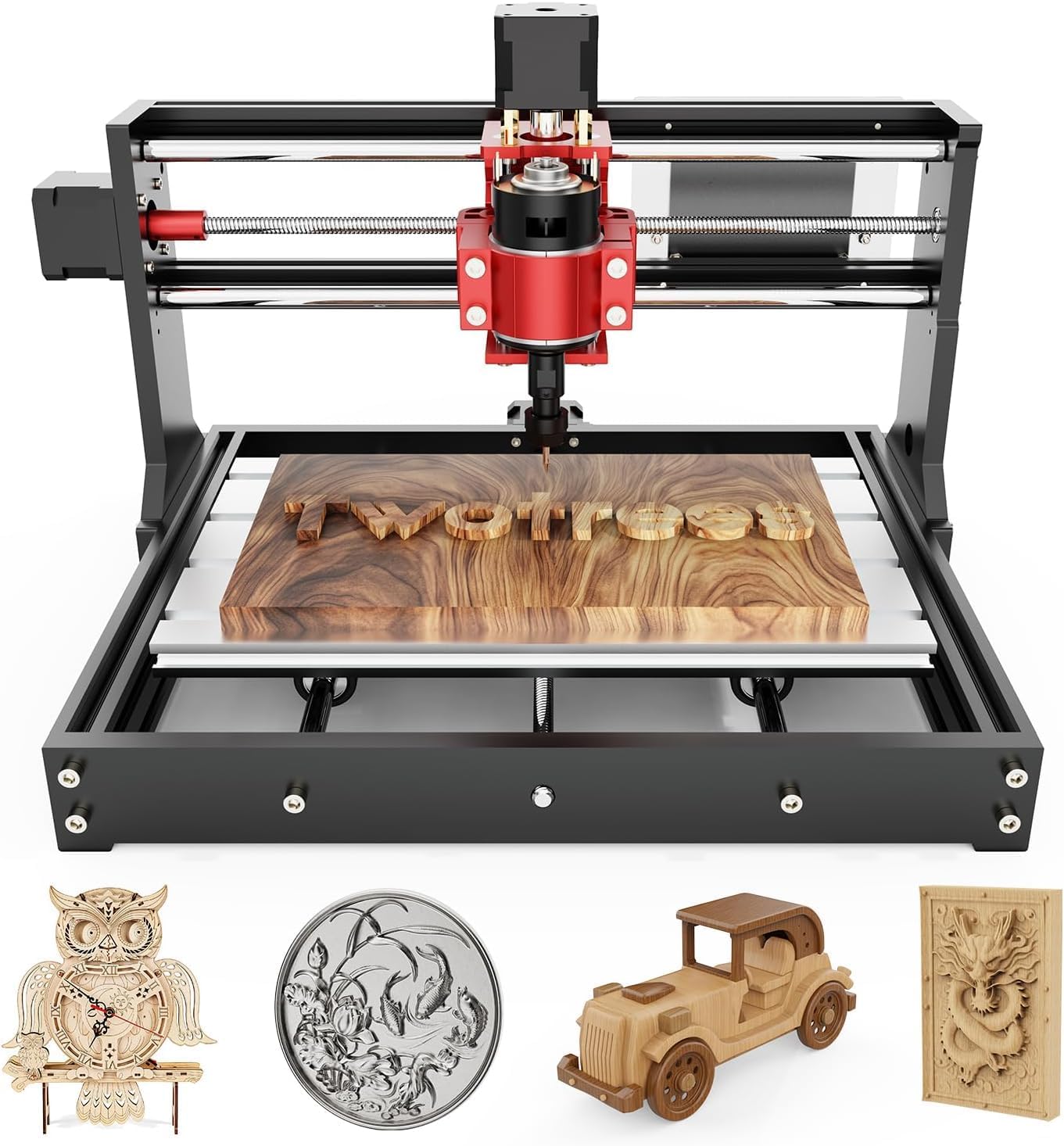
Top 3018s
300 × 180 × 45 mm · 775 spindle · GRBL

RATTMMOTOR 3018-PRO CNC Router

The plain 3018-PRO recipe from the Changzhou motor maker behind it: moulded frame ends, an aluminium table, stainless lead screws and a 775 spindle, sold bare or with an SD-card offline controller.

  • Working area300 × 180 × 45 mm
  • Spindle775, 12–24V, 10,000 rpm at 24V
  • SteppersNema 17 (42 mm), 1.3A per phase
  • ControllerGRBL board with E-stop and limit inputs
  • Frame size420 × 350 × 270 mm
  • VersionsBare kit or with offline controller
Suits
  • A first 3018 for wood, acrylic, PVC and PCB work
  • Owners who want ports ready for limit switches and an E-stop
  • Workshops where a laptop should not sit next to the machine
Skip if
  • Aluminium brackets or deep pockets in metal
  • Anyone who wants switches and a stop button in the box
  • Buyers who need 60 mm or more of Z clearance
Get it here
Kit contents

Bare kit or offline controller

The RATTMMOTOR 3018-PRO: moulded ends, aluminium table, 775 motor

RATTMMOTOR is a Changzhou motor maker, and its 3018-PRO is the template many other badges follow. The same factory is named as the manufacturer of the CNCTOPBAOS 3018-PRO-MAX, which explains why the two kits read almost line for line alike.

The build is the classic lightweight 3018. Black injection-moulded plates close the frame ends, an aluminium table rides the Y rods, and stainless lead screws move all three axes. On the carriage hangs a 775 brushed DC motor running on 12 to 24V, turning 10,000 rpm at 24V.

  • Envelope: 300 × 180 × 45 mm of travel, inside a 420 × 350 × 270 mm frame.
  • Motors: 42 mm steppers rated 1.3A per phase, 2.1 ohm, 0.25 N·m of holding torque.
  • Board: GRBL with a cooling fan, a power button, and inputs for an E-stop, limit switches and a probe.
  • Paperwork: a paper manual plus a USB flash drive holding the software and files.

Weight is light at about 6.6 kg, which keeps it easy to lift onto a shelf. The same lightness is the frame's main limit when the bit meets harder stock.

45 mm is travel, not clearance. A spoilboard, the clamps and the length of bit below the collet all come out of that figure, so a blank thicker than about 20–25 mm needs planning before it goes on the bed.

Two versions exist. The bare kit ships with the board and nothing else to control it; the 3018PRO-OL adds an offline controller that runs files from a card. The 3018 Pro guide sets this build next to Genmitsu's and CNCTOPBAOS's.

Measurements

The spec log

SpecValue
Model3018PRO (offline version 3018PRO-OL)
MakerRATTMMOTOR (RTM)
Working area300 × 180 × 45 mm (11.8 × 7.1 × 1.8 in)
Frame size420 × 350 × 270 mm
FrameInjection-moulded end plates, aluminium alloy work table
Lead screwsStainless steel
Spindle775 DC motor, 12–24V
Spindle speed10,000 rpm at 24V
Stepper motors42 mm (Nema 17), 12V, 1.3A phase current
Stepper resistance and torque2.1 ohm per phase, 0.25 N·m
ControllerGRBL 1.1 board with cooling fan and power switch
Board inputsE-stop, X/Y/Z limit switches, tool-setting probe
Spindle supportBoard drives spindles up to 20,000 rpm
Offline controllerIncluded on 3018PRO-OL; SD and TF cards
DocumentsPaper manual and USB flash drive with files
Weight6.64 kg (6.71 kg with offline controller)
MaterialsWood, plastic, acrylic, PVC, PCB, carbon fibre, density board, copper, aluminium
Not forGlass, hard metal, jade

Pine signs, PVC foam and FR4 on the RATTMMOTOR's 10,000 rpm 775

A 775 motor at 10,000 rpm and a moulded frame steer the RATTMMOTOR toward soft materials. RATTMMOTOR's material range runs from wood, plastics, PVC and circuit board through carbon fibre and fibreboard to soft copper and aluminium, and draws the line at glass, hard metal and jade.

Spindle speed and bit size set the feed. With a two-flute 1/8-inch end mill at 10,000 rpm, each flute takes a small chip per revolution, so the feed rate equals rpm × flutes × chip load. At a modest chip load in softwood that works out to several hundred millimetres per minute, with shallow depth per pass.

MaterialBitDepth per passNotes
Pine and poplar1/8 in two-flute flat0.5–1 mmSigns and pockets; clear chips often
PVC foam boardSingle-flute O-flute1–1.5 mmCuts clean; keep feed up so it does not melt
Cast acrylicSingle-flute O-flute0.3–0.5 mmAir blast helps; slow feed melts the edge
FR4 copper-clad20–30° V-bit0.05–0.1 mmIsolation traces; level the board first

These are starting points from common 3018 practice, not maker figures. Every frame, bit and board of wood behaves a little differently, so a test pocket on scrap comes first.

  • Brass and copper: engraving only, a V-bit at shallow depth.
  • Aluminium: thin sheet and lettering at very light passes; the frame flexes before the motor stalls.
  • Carbon fibre: cuts, but the dust is harmful, so use extraction and a mask.

For a first job, a pine name sign in a 1/8-inch bit shows what the machine does well without stressing the moulded ends. The materials entry covers starter cuts in more depth.

In the lineup

Where it lands among 3018 gear

3018 CNC machine models by type, September 2026. Highlighted: RATTMMOTOR 3018-PRO CNC Router.

Running a TF-card job on the 3018PRO-OL with no laptop

The offline version adds a small handheld controller that plugs into the GRBL board. It reads G-code from an SD or TF card, jogs the axes, and starts or stops the spindle, so the machine can live in a garage while the computer stays indoors.

RATTMMOTOR rates the controller for standard 1GB cards. Once the file sits on the card, the controller recognises it directly and runs it from start to finish.

  1. Export the toolpath as G-code from the CAM program, in millimetres, with no tool-change commands.
  2. Copy the file to the card's root folder and insert it in the controller.
  3. Jog X, Y and Z to the work origin and zero each axis on the controller.
  4. Start the spindle, select the file and run it; keep a hand near the power switch.

The bare kit can add the same feature later. Its board automatically detects an offline controller when one is plugged in.

Add the switches the board already expects. Both versions have inputs for an emergency stop and for X, Y and Z limit switches, but the kits do not list them in the box. A six-switch kit and a stop button make homing possible and give a hard way to halt a crash.

Homing is the practical payoff. With limit switches wired and GRBL setting 22 turned on, every session starts from one repeatable origin, and a job interrupted by a power cut can restart from a known position.

  • E-stop: wire it to the board's E-stop port so it cuts motion, not just the spindle.
  • Probe: a touch plate on the probe input sets Z zero in seconds.
  • Laptop route: Candle and UGS work over USB, as the software entry covers.
Swap-ins

Three other ways to go

Most-bought 3018 kit1 Genmitsu 3018-PRO CNC Router Kit
Genmitsu 3018-PRO CNC Router Kit
Genmitsu 3018-PRO with an offline controller and 300 × 180 × 45 mm of travel
  • 300 × 180 × 45 mm
  • 775 brushed spindle, ER11 collet
  • Offline controller: runs without a PC
Get it here
Cased board and laser port2 CNCTOPBAOS 3018-PRO CNC Router
CNCTOPBAOS 3018-PRO CNC Router
CNCTOPBAOS 3018-PRO with a GRBL 1.1f board and offline controller
  • 300 × 180 × 45 mm
  • 775 brushed spindle, ER11 collet
  • Offline controller: runs without a PC
Get it here

RATTMMOTOR against Genmitsu, CNCTOPBAOS and Twotrees

Four 3018s share the same basic recipe: 300 × 180 mm of travel, a 775 spindle and a GRBL board. Where they differ is the Z carriage, what arrives in the box, and how much documentation and support stand behind the kit.

The RATTMMOTOR is the plain version of the idea. It has the full set of board inputs and a clear offline option, but it expects the owner to add switches, a probe and a spoilboard.

MachineStands out forTrade-off
RATTMMOTOR 3018-PROSimple kit, offline option, full board inputsSwitches and E-stop not listed in the box
Genmitsu 3018-PROOffline controller included, large owner communityMoulded Z carriage like most 3018s
CNCTOPBAOS 3018-PROCased board with a laser portClose sibling, little to separate them
Twotrees TTC3018 ProAll-metal Z with a T8 anti-backlash screwUSB only, no card slot

For wood and plastic signs, any of the four does the job. The deciding points are whether the machine should run without a computer and how soon metal work is on the list.

  • Want PC-free jobs: the RATTMMOTOR 3018PRO-OL or the Genmitsu kit.
  • Want a stiffer Z: the Twotrees Pro, or an aluminium Z upgrade later.
  • Want room to grow: check that the frame takes a 3040 extension before settling on a brand.

Before ordering, measure the bench. The frame needs 420 × 350 mm of footprint plus clearance for the table to travel, and cables should reach the board without being stretched. A sheet of plywood under the frame and a shop vacuum within reach finish the setup, since chips from the first sign travel further than expected.

Bench notes

Setup questions

How thick a blank fits under the RATTMMOTOR 3018-PRO?

The Z axis travels 45 mm. After a spoilboard, clamps and bit stick-out, blanks of roughly 20–25 mm are comfortable; thicker stock needs a short bit and careful zeroing.

Does it come with limit switches and an E-stop?

The GRBL board has inputs for both, but the kits do not list the switches or the stop button as included. Plan to add them.

What does the offline controller read?

SD and TF cards; RATTMMOTOR quotes a standard 1GB card. G-code files go in the card's root folder.

Can it cut aluminium?

Thin sheet and engraving in very light passes. The 775 spindle and moulded frame limit it to soft metal work at shallow depth.