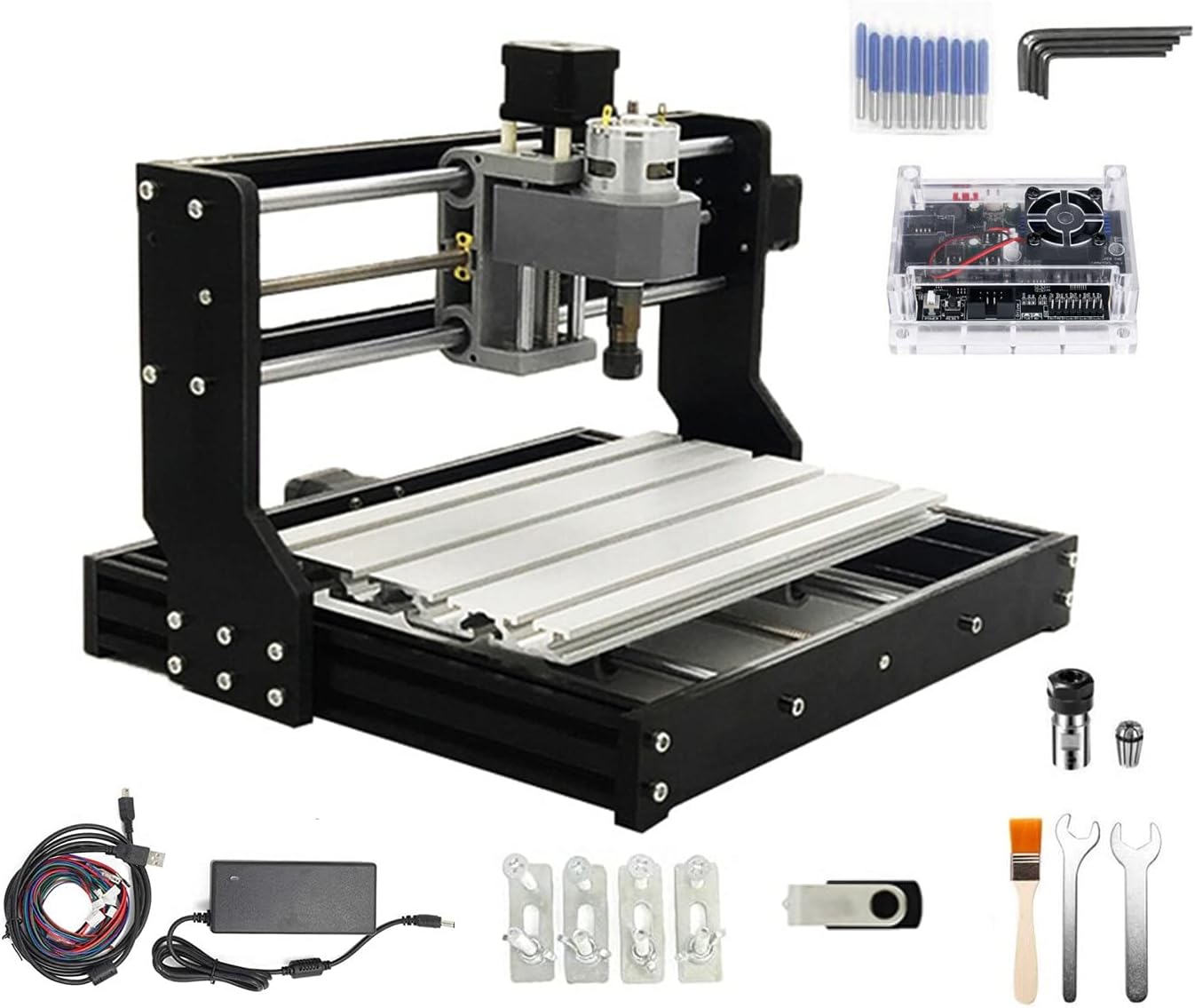
- 300 × 180 × 45 mm
- 775 brushed spindle, ER11 collet
- Offline controller: runs without a PC
The classic 3018-PRO recipe from the Changzhou factory behind RATTMMOTOR: nylon side plates on aluminium profile, a 775 spindle, Nema17 steppers and a cased GRBL 1.1f board, in five kit configurations.
The CNCTOPBAOS 3018-PRO is the textbook 3018: a 300 × 180 × 45 mm work area, a 775 brushed spindle and three Nema17 steppers on T8 screws. It is built by Changzhou Rattm Motor, the same factory named on RATTMMOTOR's 3018-PRO, so the two share much of their hardware.
The frame mixes materials. Side plates are PA6 nylon, the gantry and base rails are aluminium profile, the worktable is aluminium and the screws are stainless. Nylon keeps the weight down to 6.7 kg and damps some vibration, but it flexes more than an all-metal frame under a heavy cut.
The spindle sets what the machine is good at. A 775 motor rated 120 W reaches 10,000 rpm at 24 V, which suits small bits in soft and medium materials:
The GRBL 1.1f board is the better half of the package. It sits in a case with a fan and power switch, and it has ports for an E-stop, probe, three limit switches and the offline controller, so every common 3018 add-on plugs straight in.
The broader 3018-PRO comparison puts this kit next to the other builds of the same frame.
| Spec | Value |
|---|---|
| Brand | CNCTOPBAOS |
| Manufacturer | Changzhou Rattm Motor Co., Ltd |
| Working area | 300 × 180 × 45 mm (11.8 × 7.1 × 1.8 in) |
| Frame size | 420 × 350 × 270 mm (16.53 × 13.78 × 10.63 in) |
| Frame | PA6 nylon (resin) side plates on aluminium profile |
| Worktable | Aluminium alloy |
| Lead screws | Stainless steel |
| Spindle | 775 motor, 120 W, 12–36 V |
| Spindle speed | 10,000 rpm at 24 V |
| Stepper motors | Nema17, 1.33 A, 0.3 N·m (43 oz-in), 42 × 42 × 34 mm |
| Controller | GRBL 1.1f board, outer case, cooling fan, power switch |
| Board ports | E-stop, probe, X/Y/Z limits, offline controller |
| Spindle drive | Supports spindles up to 20,000 rpm |
| Laser support | 12 V 3-pin PWM/TTL modules, 0.5–20 W |
| Power | 24 V, 5.6 A |
| Connection | USB |
| Software and OS | GRBL software on a 4 GB USB drive; Windows XP SP3 to 11, Linux |
| File types | .nc, .txt, .tape, .gcode |
| Weight | 6.7 kg |
Every CNCTOPBAOS 3018-PRO shares the frame, spindle, motors and board. The five kits differ only in what is added for control and safety.
| Kit | Offline controller | Limit switches + E-stop |
|---|---|---|
| Base machine | No | No (ports on the board) |
| With offline controller | Yes, SD card | No |
| With limit switches and E-stop | No | Yes |
| Offline + switches | Yes, SD card | Yes |
| Touchscreen kit | Yes, 2.8-inch touch LCD | Yes |
The offline controller reads G-code from an SD card and lets you jog X, Y and Z, set the work zero and start or stop the spindle with no computer attached. It is the difference between a laptop tethered to the machine for every job and a machine that runs on its own in the garage.
Limit switches and an E-stop are the safety pair. The switches stop an axis that runs past its travel, and the button kills motion mid-job when a clamp is about to meet the bit.
All five use the same USB link and GRBL 1.1f firmware, so a job file made for one runs on any other. The offline controller is a convenience layer, not a different machine.
The switch-equipped kits also change the look: the Y-axis side plates are orange resin boards instead of black. That is the quick way to tell them apart in photos.
A 775 at 10,000 rpm cuts well when the bit is small and the chip is thin. The figures here are cautious starting points for 1/8-inch bits; bit sharpness, stick-out and clamping move them a lot, so cut a test piece first.
| Material | Bit | Feed to start | Depth per pass |
|---|---|---|---|
| Birch plywood | 2-flute flat, 1/8 in | 300–500 mm/min | 0.5–1 mm |
| Expanded PVC | 1-flute, 1/8 in | 400–600 mm/min | 1–1.5 mm |
| Cast acrylic | 1-flute, 1/8 in | 300–400 mm/min | 0.3–0.5 mm |
| FR4 isolation | V-bit, 20–30° | 100–200 mm/min | 0.05–0.1 mm |
| Brass engraving | Carbide V-bit | 100–150 mm/min | 0.05–0.1 mm |
The machine tells you when a number is wrong. A squeal and melted edges on acrylic mean the feed is too slow; a hammering gantry and a stalling note from the 775 mean the depth is too greedy.
Limits worth knowing before buying:
A laser swap turns the kit into a 2-in-1 for leather, cardboard and wood marking. The 3018 laser rundown covers the 5W and 10W modules that fit this bracket style.
Most 3018-PRO kits share the same bones, so the differences sit in the controller, the extras in the box and the support behind the brand.
| Machine | Work area | Spindle | Controller notes |
|---|---|---|---|
| CNCTOPBAOS 3018-PRO | 300 × 180 × 45 mm | 775, 120 W | GRBL 1.1f, cased, five kits |
| Genmitsu 3018-PRO | 300 × 180 × 45 mm | 775 class | GRBL, offline controller included |
| Twotrees TTC3018 | 300 × 180 × 40 mm | 775, 7,000–9,000 rpm, ER11 | 32-bit STM32, GRBL |
| RATTMMOTOR 3018-PRO | 300 × 180 × 45 mm class | 775, 10,000 rpm at 24 V | GRBL, offline-ready |
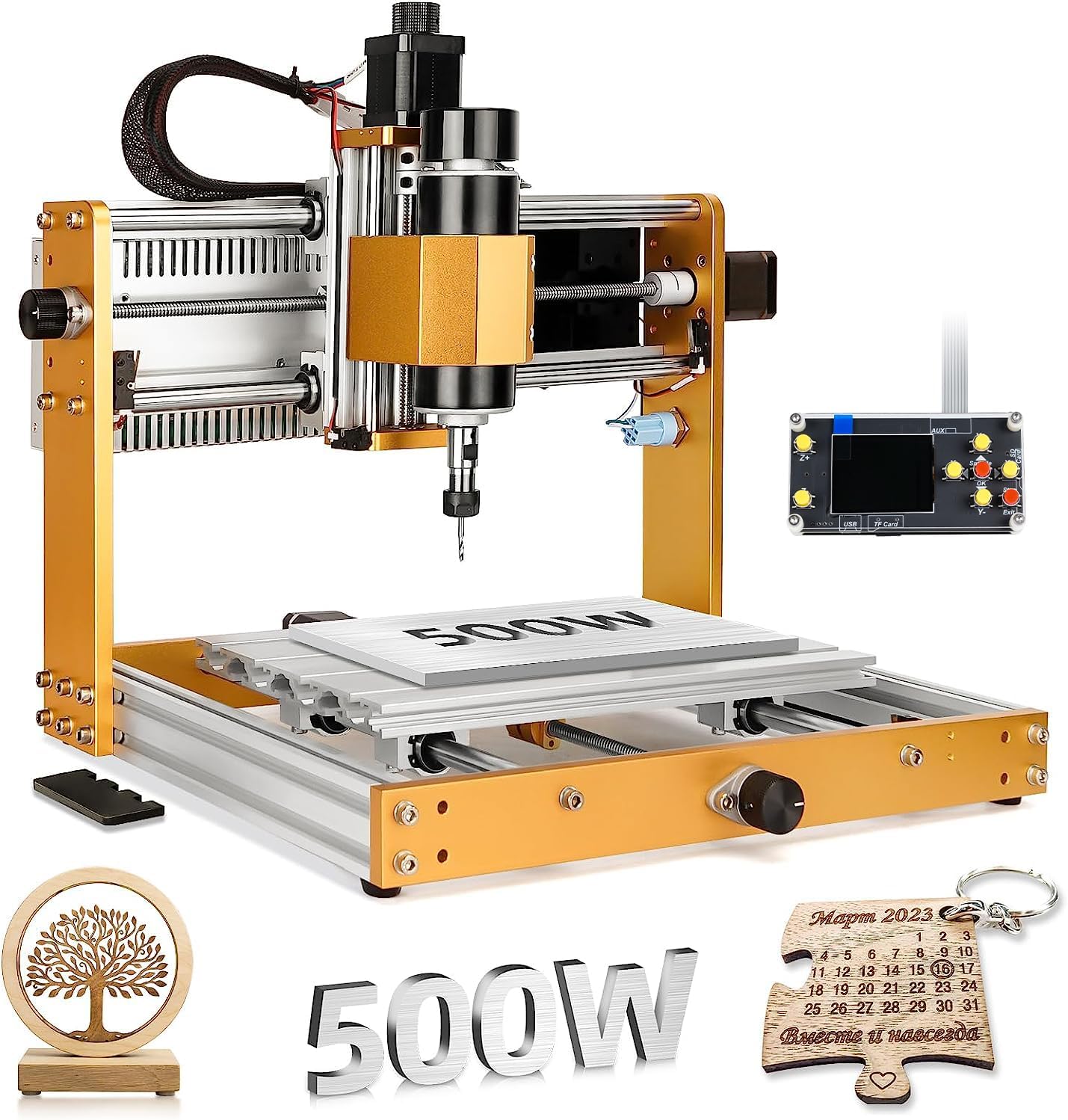
| LUNYEE 3018 Pro Max | 300 × 180 × 80 mm | 500W | GRBL offline, all-metal frame |
Genmitsu brings the larger support library and a big range of parts made for its own frame. Twotrees moves to a 32-bit board. CNCTOPBAOS gives the widest choice of kits on one machine, up to the touchscreen with switches.
Shared parts cut both ways. A 775 motor, T8 nut or Nema17 from any of these 3018-PRO kits will usually swap into another, which keeps spares cheap and easy to find. Brand-specific add-ons, such as a maker's own Z assembly or bed extension, are where you need to check dimensions before assuming a fit.
Before ordering, check:
The machine is the same in all five. Kits add an SD-card offline controller, limit switches with an E-stop, both, or a 2.8-inch touchscreen controller with switches.
Yes. The GRBL 1.1f board supports 12 V 3-pin PWM/TTL laser modules from 0.5 W to 20 W.
Both are made by Changzhou Rattm Motor and share the 775, Nema17 and GRBL recipe. Kit contents differ between the two brands.
GRBL senders such as Candle and UGS, on Windows XP SP3 to 11 or Linux. The software ships on a 4 GB USB drive.
It can engrave and take very light passes in aluminium, brass and copper. Regular aluminium work suits a 500W, all-metal machine better.