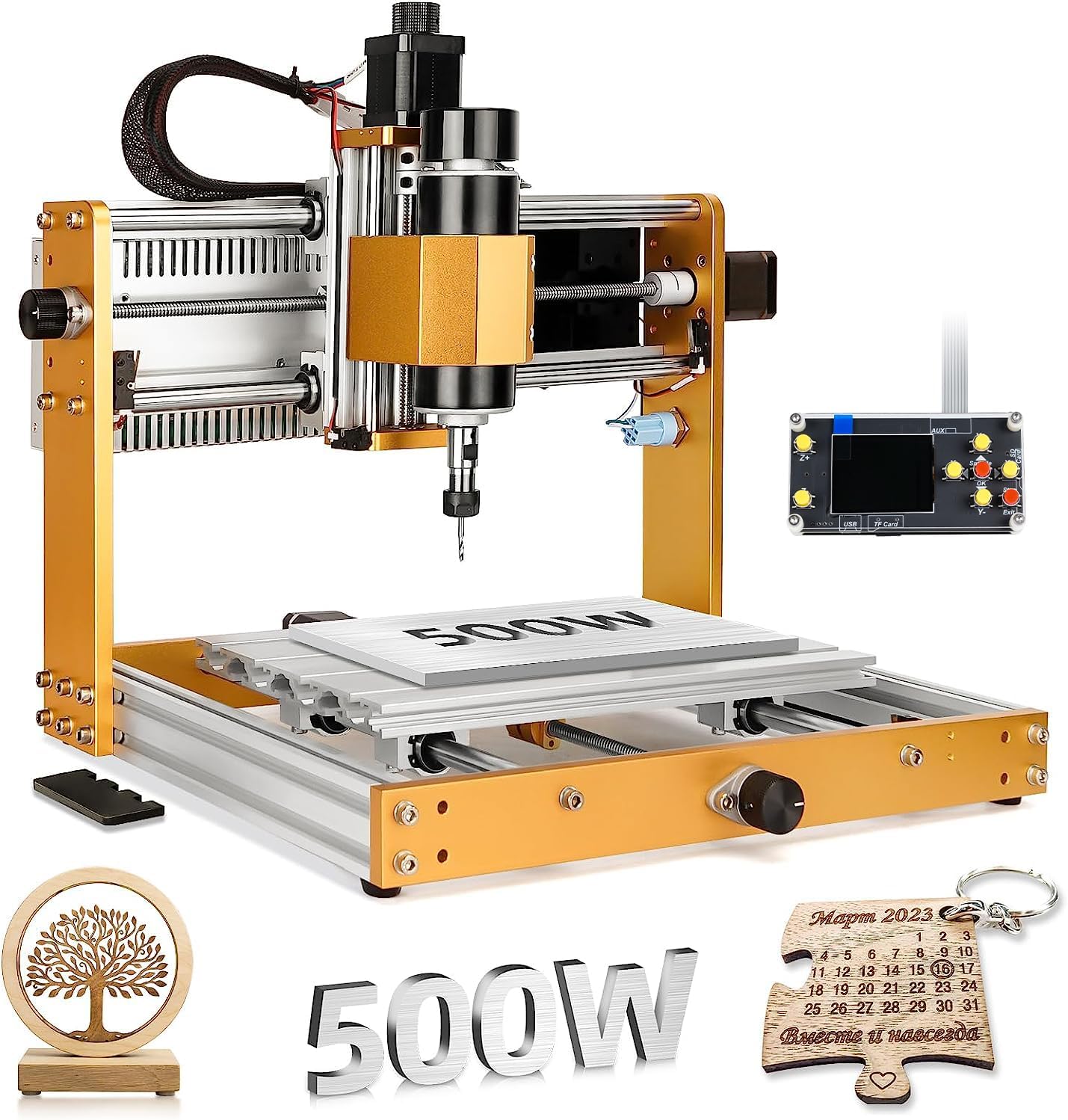
- Work area 300 × 180 mm
- GRBL control over USB
A classic 775-spindle 3018 in a black moulded frame, with a GRBL 1.1 board ready for an emergency stop, limit switches, a probe and an offline controller when the owner adds them.
The name invites confusion. In the 3018 world, Pro Max can mean a 500W all-metal machine with 80 mm of Z, as LUNYEE uses it, or a classic 775-spindle kit with an upgraded board, as RATTMMOTOR does. The RATTMMOTOR 3018-PRO MAX is the second kind.
What the MAX brings is a 3018-PRO frame with a better controller than the earliest kits:
The mechanics are the standard recipe: black PA6 nylon plates on aluminium profile, stainless lead screws, NEMA 17 steppers and a 775 spindle on an ER11 collet. The envelope is 300 × 180 × 45 mm in a frame 420 × 350 × 270 mm.
Once built, the first test is the same as on any GRBL kit: connect over USB, check the software reads Idle, power the 24V supply, spin the spindle up and jog each axis at a feed of 200 to 500.
How the badges line up across makers is laid out in the 3018 Pro Max comparison.
| Spec | Value |
|---|---|
| Model | 3018Pro-M+ |
| Working area | 300 × 180 × 45 mm (11.8 × 7.1 × 1.8 in) |
| Frame size | 420 × 350 × 270 mm (16.53 × 13.78 × 10.63 in) |
| Frame | Black injection-moulded PA6 nylon plates on aluminium profile |
| Work table | Aluminium alloy |
| Lead screws | Stainless steel |
| Spindle | 775 motor, 100W, 12–24V DC, 10,000 rpm at 24V, double ball bearings |
| Collet | ER11, 3.175 mm fitted; takes 0–7 mm ER11 collets |
| Stepper motors | NEMA 17 (42 mm), 1.3 A, 2.1 Ω, 0.25 N·m |
| Controller | GRBL 1.1 board in a case, integrated stepper drivers, power switch, fan port |
| Controller ports | E-stop, X/Y/Z limits, probe, offline controller |
| Spindle drive | PWM, optocoupler-isolated, supports spindles up to 20,000 rpm |
| Power supply | 24V 5.6A adapter, 110–240V input |
| Accuracy | About 0.2 mm (maker's figure) |
| Included bits | 10 tungsten steel V-bits: 3.175 mm shank, 20°, 0.1 mm tip, 15 mm blade, 38 mm long |
| In the box | Machine kit, power supply, 10 bits, 4 plate clamps, English manual, 4 GB USB drive, Allen wrench set |
| File formats | 3-axis: nc, ncc, tap, txt; 2-axis also ngc, png, jpg, gif, svg |
| Bundles | Machine only, or with an offline controller |
RATTMMOTOR's material list for the MAX is longer than most: wood, plastic, acrylic, PVC, PCB, carbon fibre, fibreboard, plastic phone cases, rubber stamps, copper and aluminium. It rules out glass, stone, jade, ceramics and stainless steel. A few of those materials need habits that plywood never teaches.
| Job | Tool | Watch for |
|---|---|---|
| Rubber stamp | Flat end mill, then 20° V-bit | Mirrored artwork |
| Carbon fibre plate | Carbide end mill | Dust extraction, board protection |
| PVC sign | 2-flute flat | Chips sticking in the slot |
| Brass or aluminium tag | V-bit, engraving only | Chatter; go slower |
The quoted accuracy of about 0.2 mm is ample for stamps, signs and through-hole PCBs. Fine-pitch surface-mount boards sit at the edge of it, and are better left to a stiffer frame with a sharper engraving bit. Material-by-material starting feeds are gathered in what a 3018 cuts.
The MAX is a machine to grow into. Its board carries more ports than the box fills, the collet takes more than one shank size, and the spindle drive is rated for a faster motor than the one fitted. Each of those is a cheap next step.
What the MAX will not become is an aluminium mill. The 775 holder, the moulded plates and 45 mm of Z set a ceiling that parts cannot lift much. Owners who outgrow it tend to move to a 500W frame rather than rebuilding this one.
The full upgrade order, with the cheapest wins first, is in 3018 upgrades.
Three machines compete for the same buyer. RATTMMOTOR's own Upgrade model adds safety parts, CNCTOPBAOS's PRO-MAX adds an offline controller, and LUNYEE's Pro Max moves to a different class with 500W and an all-metal frame. The table sorts them by what each adds.
| Machine | Spindle | Z travel | Adds |
|---|---|---|---|
| RATTMMOTOR 3018-PRO MAX | 775, 100W | 45 mm | GRBL 1.1 board with every port |
| RATTMMOTOR Upgrade 3018-PRO | 775, 100W | 45 mm | E-stop and 3 limit switches in the box |
| CNCTOPBAOS 3018-PRO-MAX | 775, 120W, 12–36V | 45 mm | Offline controller included |
| LUNYEE 3018 Pro Max | 500W, 0–12,000 rpm | 80 mm | All-metal frame, 6 switches, E-stop |
Pick the RATTMMOTOR MAX if:
Pick the Upgrade if homing and a stop button should be there on day one. Pick the CNCTOPBAOS if cutting without a computer matters most. Move to the LUNYEE if aluminium, brass or thick hardwood is on the list, since that is where a 500W spindle and 80 mm of Z earn their keep.
The two RATTMMOTOR kits and the CNCTOPBAOS share a maker and much of the hardware, so parts cross over between them easily. That makes the plainer MAX a reasonable start: the switches, stop and offline pad of the other two can all be added later.
Across all four, check the same three things: working area against the largest planned part, the collet size against the bits already owned, and whether the kit or the finished-machine route suits the evening available for building.
No. It uses a 100W 775 spindle at 10,000 rpm on 24V. The 500W, 80 mm-Z Pro Max is LUNYEE's machine.
300 × 180 × 45 mm (11.8 × 7.1 × 1.8 in), inside a frame of 420 × 350 × 270 mm.
The board has ports for them. RATTMMOTOR's Upgrade 3018-PRO is the model that ships with the switches and stop button.
The ER11 collet fitted takes 3.175 mm (1/8-inch) shanks; other ER11 collets up to 7 mm cover larger shanks.
Yes, with an offline controller. The MAX is offered bundled with one, and the board has the port.