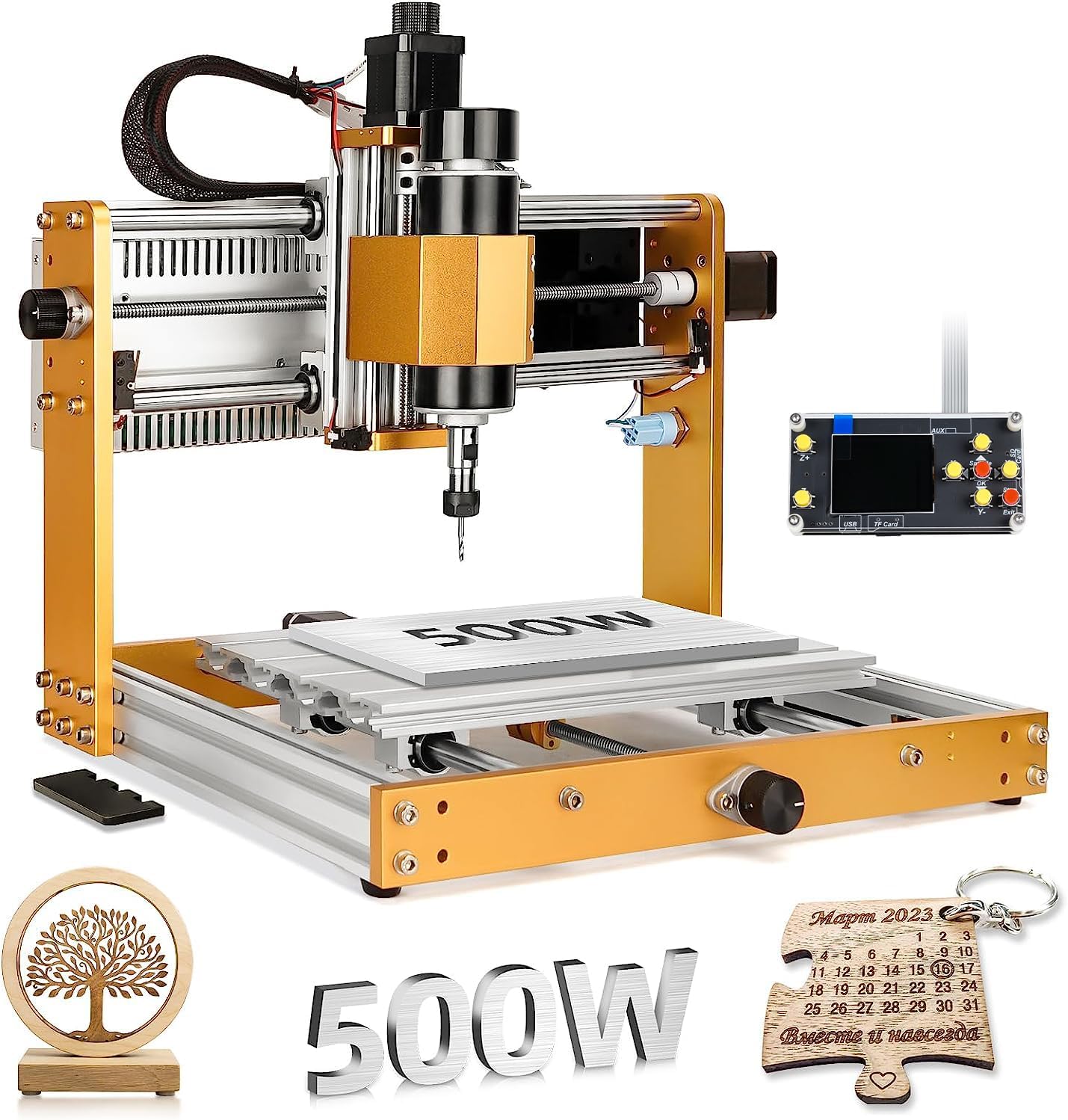
- 300 × 180 × 45 mm
- 775 brushed spindle, ER11 collet
- Offline controller: runs without a PC
The light, 775-powered side of the Pro Max name: a classic 3018 frame with a cased GRBL 1.1f board that has a port for everything, sold bare, with an SD-card offline controller, or with switches and a stop button too.
The CNCTOPBAOS 3018-PRO-MAX keeps the proven 3018 formula and spends its upgrades on the electronics. It moves 300 × 180 × 45 mm within a frame of 420 × 350 × 270 mm, a 775 motor on the carriage, and a GRBL 1.1f board that sits in its own case with a fan.
Changzhou Rattm Motor is named as the maker, the same factory behind the RATTMMOTOR kits. That shows in the numbers, which match RATTMMOTOR's 3018 builds almost everywhere except the motor figures.
The Pro-Max name can mislead. Other Pro Max machines, such as LUNYEE's, carry a 500W spindle and 80 mm of Z. This one is a 775 machine, closer in spirit to a well-equipped 3018-PRO.
G-code files can be .nc, .txt, .tape or .gcode, so output from most CAM programs runs without renaming. The 3018 Pro Max comparison puts this kit next to the 500W machines that share the name.
| Spec | Value |
|---|---|
| Model | 3018-PRO-MAX |
| Brand | CNCTOPBAOS (made by Changzhou Rattm Motor) |
| Working area | 300 × 180 × 45 mm (11.8 × 7.1 × 1.8 in) |
| Frame size | 420 × 350 × 270 mm |
| Frame material | Aluminium |
| Spindle | 775 DC motor, 120W, 12–36V |
| Spindle speed | 10,000 rpm at 24V |
| Collet | ER11 with 3.175 mm collet; 0–7 mm collets fit |
| Stepper motors | Nema 17, 1.33A, 0.3 N·m (43 oz-in), 42 × 42 × 34 mm |
| Controller | GRBL 1.1f board in a casing, with fan and power switch |
| Board ports | E-stop, probe, X/Y/Z limits, offline controller |
| Spindle drive | Supports spindles up to 20,000 rpm |
| Laser support | 12V 3-pin PWM/TTL modules, 0.5–20W |
| Power | 24V, 5.6A adapter |
| Offline controller | SD card reader, manual XYZ jog, spindle on/off (on offline versions) |
| Files | G-code .nc, .txt, .tape, .gcode |
| Computer | USB; Windows XP to 10, Linux |
| In the box | Kit, English manual, 4GB USB drive with software and instructions |
A 10,000 rpm 775 and 45 mm of Z suit shallow, detailed work. CNCTOPBAOS lists plastic, wood, acrylic, PVC and PCB, plus copper and aluminium, and the frame handles the first five comfortably.
Plywood trays, coasters, signs and small boxes are the machine's natural jobs. So are copper-clad circuit boards, where a V-bit isolates traces a few hundredths of a millimetre deep and spindle power barely matters.
| Project | Bit | Approach |
|---|---|---|
| Birch ply tray | 1/8 in two-flute flat | Pocket in 0.5–1 mm steps, finish pass at full depth |
| Single-sided PCB | 20° V-bit | Probe or level the board, cut 0.05–0.1 mm deep |
| Acrylic panel | Single-flute O-flute | Shallow passes, air to clear chips |
| PVC foam sign | 1/8 in O-flute | Deeper passes, brisk feed |
| Brass tag | V-bit | Engrave only, very light depth |
These are common 3018 starting points, not CNCTOPBAOS figures. A scrap test on each new material is still the first job.
Aluminium sits at the edge of what the frame does well. Thin sheet and engraved plates work; pockets in 6061 call for a stiffer 500W frame.
The board is where this kit earns the Max in its name. CNCTOPBAOS gave it a casing, a fan, a power switch and a full set of ports, so the usual upgrades plug in without swapping controllers.
That matters because most 3018 owners add parts within the first months. A board with the ports already in place saves a controller swap later.
The laser output turns the kit into a two-head machine. Swap the 775 for a diode module, switch GRBL into laser mode (setting 32 at 1), and the same frame engraves wood, leather and card.
The offline controller reads G-code from the SD card's root folder, jogs X, Y and Z to the starting point, and switches the spindle. The software entry covers the computer side, and the laser entry the diode options that fit this board's 12V output.
Three machines sit close to this kit. The CNCTOPBAOS 3018-PRO shares most of its specification, the RATTMMOTOR 3018-PRO MAX comes from the same factory, and the LUNYEE 3018 Pro Max carries the same name with a far heavier build.
Against the CNCTOPBAOS 3018-PRO, differences are small. Both run a 775, a GRBL 1.1f board with the same ports and an offline controller option, and both quote the same 300 × 180 × 45 mm envelope. The choice between them usually comes down to which offline controller each version ships with and which box includes the safety parts.
Against the LUNYEE, the gap is large. The LUNYEE pairs 500W with a metal frame and nearly twice the Z stroke, which opens up aluminium and thick hardwood, and it weighs far more on the bench. For wood, plastic and circuit boards, the lighter Pro-Max does the same jobs on a frame that is easier to lift and move.
| Machine | Spindle | Z travel | What stands out |
|---|---|---|---|
| CNCTOPBAOS 3018-PRO-MAX | 775, 10,000 rpm | 45 mm | Version with switches and E-stop in the box |
| CNCTOPBAOS 3018-PRO | 775, 10,000 rpm | 45 mm | Touchscreen offline controller version |
| RATTMMOTOR 3018-PRO MAX | 775, 10,000 rpm | 45 mm | Same maker, 20,000 rpm spindle support |
| LUNYEE 3018 Pro Max | 500W, 12,000 rpm | 80 mm | All-metal frame for soft metal |
Before ordering, check the bench: the frame needs about 420 × 350 mm plus room for the table to travel. Decide whether the machine will live next to a computer; if not, the offline version is the one to order.
No. It uses a 120W 775 motor at 10,000 rpm on 24V. The 500W Pro Max machines come from other makers such as LUNYEE.
The version sold with the offline controller plus limit switches and E-stop. The other two have the board ports but not the parts.
Yes. The board supports 12V three-pin PWM or TTL laser modules from 0.5W to 20W.
G-code files with .nc, .txt, .tape or .gcode extensions, placed in the SD card's root folder.