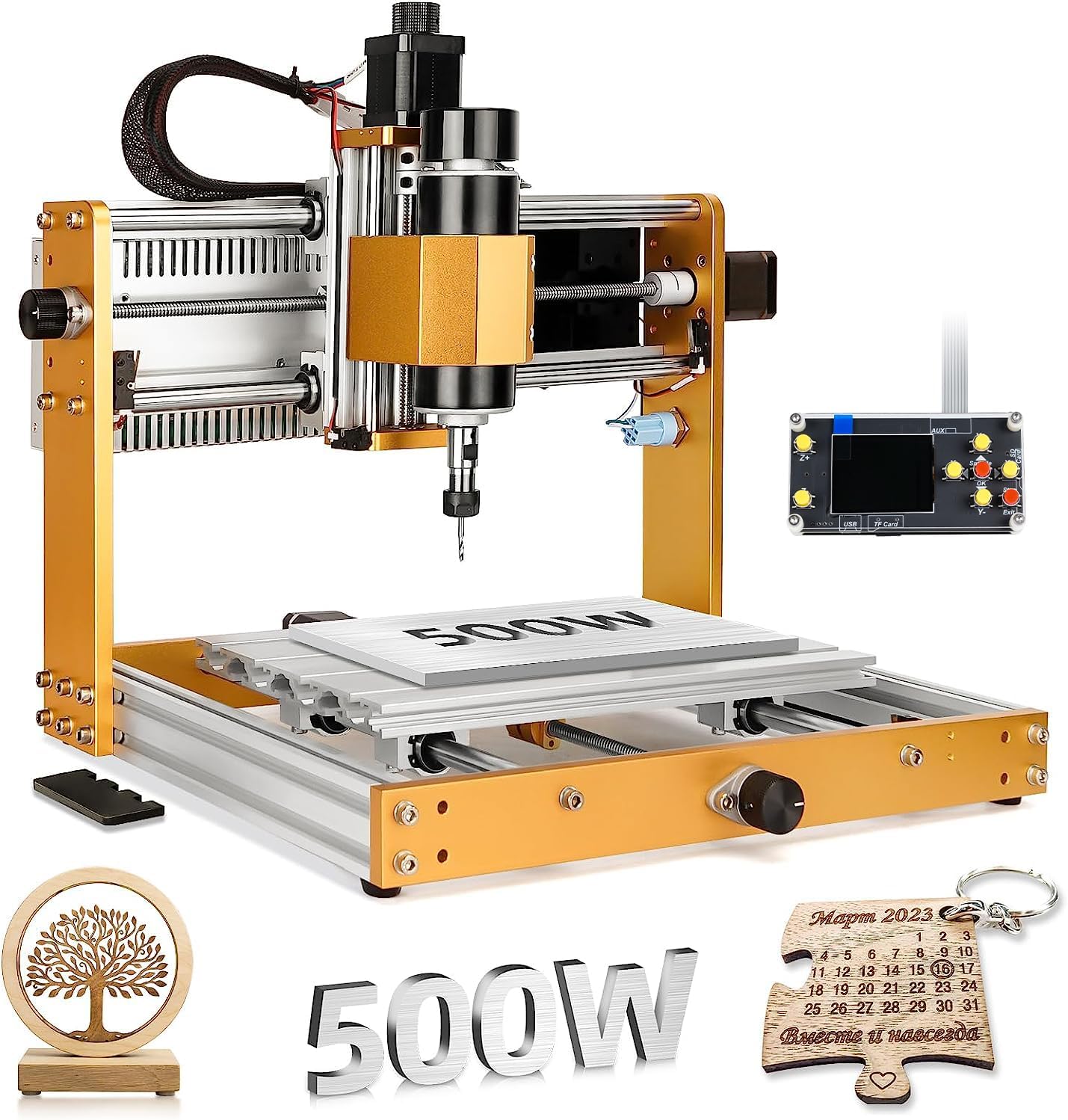
- Work area 300 × 180 mm
- Offline controller: runs without a PC
- Laser module in the box
A diode module mounts on the 3018's Z carriage and plugs into the board's 3-pin laser header, and the router becomes a 2-in-1 machine. The 5W, 5.5W and 10W modules differ in spot size, cutting depth and how they focus.
Logged September 2026Most 3018 boards drive a 12V diode module through a 3-pin VCC, GND and PWM plug, so a laser can stand in for the spindle. A 5W or 5.5W module engraves wood, leather and card and cuts thin ply; the 10W LASER TREE, by its maker's figures, cuts 8 mm plywood in one slow pass. Wear goggles rated for 450 nm whenever it fires.
A 3018 board already has what a laser needs: a PWM output that sets power, and G-code that moves the head. The diode module bolts to the Z carriage, its 3-pin plug goes into the laser header, and the same GRBL firmware draws with light instead of a bit.
The three pins are VCC, GND and PWM. The board supplies power on the first two and pulses the third to set brightness, which the G-code controls with the same S value that sets spindle speed. Several boards also accept 2-pin lasers; the Genmitsu and MYSWEETY boards route those through a separate white connector.
The idea is old. Early 3018 Pro bundles shipped a 500mW laser that marked wood but cut almost nothing. The Mostics 2-in-1 CNC 3018 Pro machine was another early kit with a laser in the box. Today the bundle to know is the Genmitsu 3018-PRO sold with a 5000mW module.
A diode is not a CO2 tube. It burns and cuts thin organic material, marks coated metal and leaves clear acrylic untouched, because blue light passes straight through it.
| Module | Optical power | Input | Spot and focus | Cut figure from the maker | Made for |
|---|---|---|---|---|---|
| LASER TREE 10W | 10W, 450 nm | 12V 3.2A, 5V PWM, XH2.54-3P plug | 0.08 × 0.08 mm with FAC lens, 45 mm focal length | 8 mm plywood, one pass at 1.5 mm/s | 3018 and 3018 Pro brackets |
| LASER TREE 5W | 5W, 450 nm | 12V 2A, 5V PWM, XH2.54-3P plug | 0.08 × 0.08 mm with FAC lens, 45 mm focal length | 3 mm plywood, one pass at 1.5 mm/s | 3018 and 3018 Pro brackets |
| Genmitsu XCFL55-33 | 5W, 450 nm | Driver board built into the head | 0.1 × 0.15 mm spot, focus module in the shield | 8 mm pine, one pass | 3018-PRO, 3018-PROVer V2, 3020, 4040 |
| Genmitsu FL55P | 5.5W | 12V 2A | Fixed focus at 20 mm | 3 mm linden, one pass | 3018-PRO, 3020-PRO MAX, ProverXL 4030, Cubiko |
Figures as each maker states them. Cutting depth depends on wood density, moisture, air assist and speed, so read them as best cases.
Power decides two things: how fast an engraving runs and how thick a cut gets. A 5W module engraves as well as a 10W one on most woods, just slower; the gap shows when the job is cutting.
The makers' own cut figures show the spread. LASER TREE rates its 5W for 3 mm plywood in one pass at 1.5 mm/s, and its 10W for 8 mm at the same speed. Genmitsu rates the fixed-focus FL55P for 3 mm linden in one pass and the XCFL55-33 for 8 mm pine, a claim that leans on its tight 0.1 × 0.15 mm spot.
The 3018's small bed caps the payoff of raw power. On 300 × 180 mm, most jobs are coasters, tags and signs, where a 5W head engraving slowly is rarely the bottleneck.
LASER TREE 10W Laser Module for 3018 |
LASER TREE 5W Laser Module for 3018 |
Genmitsu 5W Laser Module (XCFL55-33) |
Genmitsu FL55P 5.5W Laser Module |
Genmitsu 3018-PRO CNC Router with 5W Laser | |
| Type | Laser module | Laser module | Laser module | Laser module | Machine |
| Spindle | 10W | 5W | 5W laser | 5.5W | — |
| Frame | — | — | — | — | Aluminium + plastic |
| Linear guides | — | — | — | — | No |
| Offline controller | — | — | — | — | Yes |
| Fits | 3018-PRO | 3018-PRO | 3018-PROVer V2, 3018-PROVer, 3018-PRO | 3018-PRO | — |
| Get it here | Get it here | Get it here | Get it here | Get it here |
Fit comes down to the bracket and the voltage. Genmitsu designs its modules for its own carriages, and LASER TREE shapes its heads to clamp into the brackets that most 3018 and 3018 Pro frames share.
The Genmitsu XCFL55-33 names the 3018-PRO, the 3018-PROVer V2 and larger Genmitsu machines. Its driver board lives inside the head, which trims weight and cable clutter, and a shield with a built-in focus module filters stray light at the head. The FL55P 5.5W uses a fixed 20 mm focal distance, so setting height is a matter of a spacer rather than a twist of the lens.
LASER TREE's modules take 12V through an XH2.54 3-pin socket with 5V PWM control, which matches the laser header on most 3018 GRBL boards. The 10W family also comes in a 24V version with air assist, a better match for boards that pass the main supply straight to the laser pins.
CNCTOPBAOS rates its GRBL 1.1f board for 12V 3-pin modules from 0.5W to 20W, which covers every module here. On an older or unknown board, the controller upgrade notes list replacements with a proper laser port.
The 10W LASER TREE squeezes its beam to a 0.08 mm spot and, by its maker's figures, cuts 8 mm plywood in one slow pass. A 10,000 rpm fan and an air-assist design keep heat and smoke away from the lens.
Get it hereAn open 5W to 10W diode is a Class 4 laser, whatever a label says. Reflected blue light can damage an eye before the blink reflex acts, so goggles come before the first test burn.
LASER TREE labels its 24V 10W build and its 5W as Class 4, and the 12V 10W is the same class of beam. Treat every one of them as Class 4; the physics of an open multi-watt beam leaves no room for a lower class.
An enclosure helps with smoke and stray light only if it is designed for laser light. The KABA Lite is sold for dust and noise on 3018 routers, with two pre-cut holes for cables. It is not described as a laser-rated shield, so goggles stay on with the lid closed.
Genmitsu's XCFL55-33 adds a filtering shield around the head, a useful extra layer. It does not replace eyewear when the beam is framing or focusing.
The first job with a new module should be a test grid, not a gift. A test pattern of small squares, one per power and speed pairing, shows in one burn where the chosen wood darkens, where it chars and where it cuts through.
LightBurn builds such a grid automatically with its material test. In LaserGRBL, a row of separate small files gets there with a few more clicks. Both stream to the 3018's GRBL board over USB like any other G-code.
Photos need dithering, not greyscale power. LaserGRBL's dithering modes turn a picture into dots of full power at varying density, which reads as tones on birch and on leather. The software notes compare LaserGRBL and LightBurn with the milling programs.
Switch GRBL back to spindle mode before the next milling job. With laser mode still on, GRBL cuts the output during every rapid move, so the spindle would stop and restart between cuts.
Most can. The board needs a laser or PWM output, usually a 3-pin header, and the carriage needs a bracket that fits the module. Check the header voltage against the module's 12V or 24V input.
5W to 5.5W engraves wood, leather and card and cuts thin ply. A 10W module earns its place when cutting thicker plywood is the main job.
A 500mW diode marks wood, card and leather at slow speed but cuts little beyond paper. A 5W or 5.5W module is the usual upgrade; match its plug and voltage to the board's laser header first.
It depends on the bracket. Some modules mount beside the spindle, others take its place on the carriage; either way, unplug or lift the spindle so it cannot start by accident.
Dark and black acrylic, in thin sheet and several passes. Clear and white acrylic let the 450 nm beam pass through, so a diode barely marks them.
Goggles marked for 445–455 nm with an optical density of 4 or higher. Tinted glasses without a wavelength rating do not count.