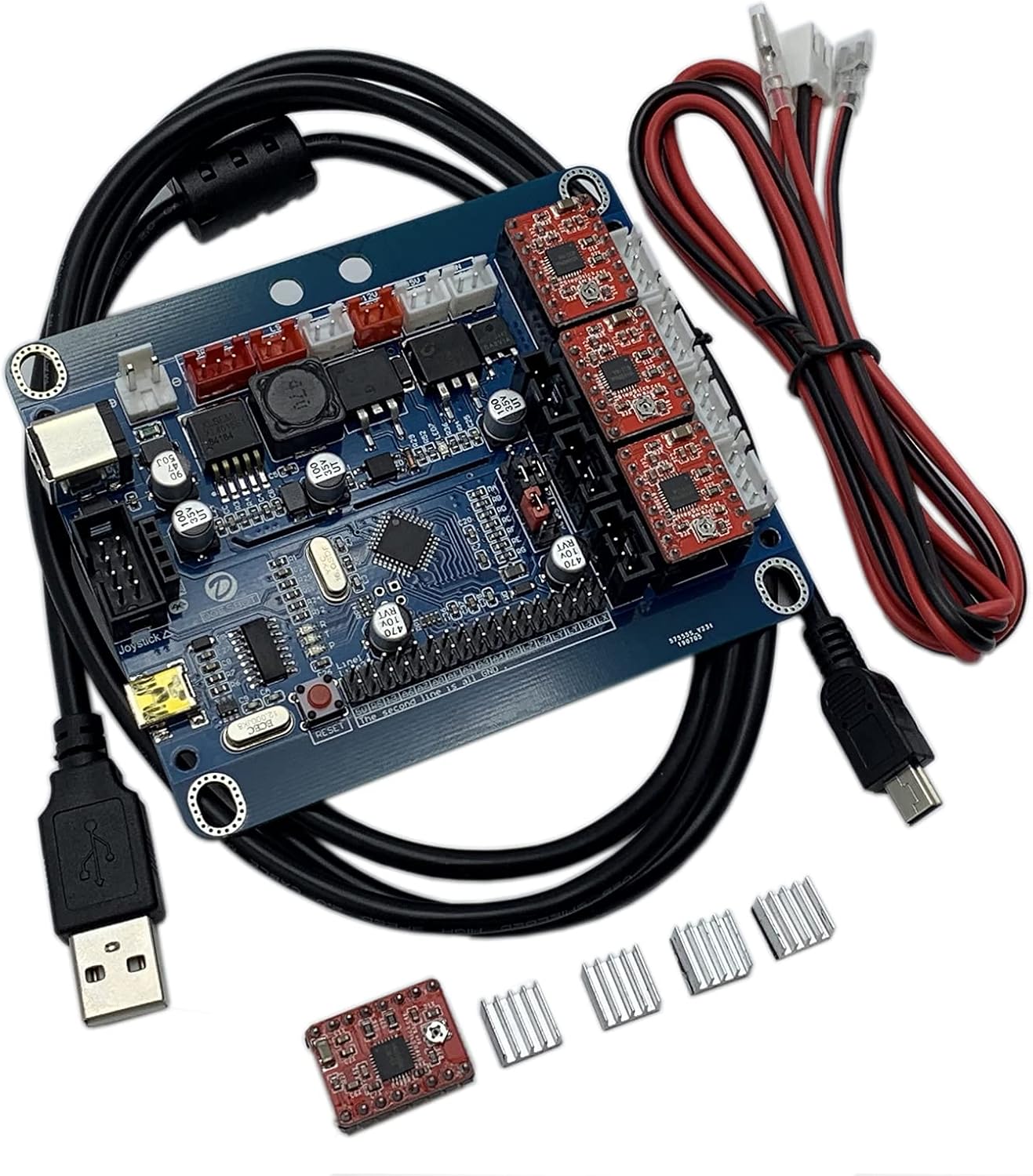
- Control electronics
- Fits 3018-PRO
A bare 3-axis GRBL board for the small desktop routers and engravers: A4988 stepper drivers, a 5 A spindle or laser output with PWM, three limit inputs and a reset button, powered from 7 to 36V.
Small GRBL routers share a controller design: an Arduino-class chip running GRBL, three plug-in stepper drivers and a MOSFET output for the spindle. When that board dies, from a shorted spindle lead or a USB socket torn off the board, the F-Yi board slots in as a direct replacement for 3018, 1610 and 2418 frames.
What sits on the board, by function:
It runs GRBL 0.8, 0.9 or 1.1 and also Benbox, the older laser-engraver software. On a 3018 the natural choice is GRBL 1.1 with Candle or UGS.
For a basic 3018 that only needs to move, spin and home, that is enough. Frames and their standard boards are compared in the 3018-PRO guide.
| Spec | Value |
|---|---|
| Axes | 3 (X, Y, Z) |
| Firmware | GRBL 0.8, 0.9 and 1.1; Benbox supported |
| Input voltage | DC 7–36V |
| Recommended supply | 12–24V at 5–10 A; match the laser's voltage when a laser is fitted |
| Stepper drivers | A4988, up to 1.5 A per axis |
| Spindle output | At supply voltage, 5 A; external relay for larger spindles |
| Spindle control | M3 on, M5 off; PWM speed with GRBL 0.9 or 1.1 |
| Laser | 3-axis laser engraving supported; PWM power control |
| Fan output | For spindle motor cooling |
| Limit inputs | X−, Y−, Z− (minimum end of each axis) |
| Reset button | Restarts the system; usable as an urgent stop |
| Connection | USB, 20 cm cable included |
| Machines named | 3018, 3018 Pro, 1610, 2418 |
| Travel setting | Set in GRBL: 300 × 180 mm for a 3018, 240 × 180 mm for a 2418 |
| Rated voltage | 24V |
| In the box | 1 GRBL control board, 1 USB cable, 3 heat sinks |
The spindle output sets the board's ceiling. It switches the supply voltage at up to 5 A, so on 24V it can feed about 120W. A stock 775 motor fits easily; bigger spindles need the board to drive a relay or a separate speed controller instead.
| Load | On a 24V supply | How to connect |
|---|---|---|
| Stock 775, around 100W | Within the 5 A output | Directly to the spindle terminals |
| 20,000 rpm 775 | Start-up current can spike | Direct, with a supply that can start it |
| 300W or 500W spindle | Beyond 5 A | Through its own power supply and speed controller; board signals only |
| Diode laser module | Laser voltage must match supply | PWM output to the laser driver |
The laser rule deserves attention. F-Yi says the supply voltage should equal the laser's voltage, because the spindle output passes the supply straight through. A 12V laser head on a 24V board supply is a quick way to kill a laser driver.
GRBL settings that shape the output:
On a 3018 that swaps between spindle and laser, keep two saved settings lists, one per head, and paste the right one in before each job. It takes seconds and avoids the classic slip: laser mode left on while the spindle cuts. Laser heads, their voltages and the goggles to wear with them are covered in 3018 laser modules.
Fitting the board mostly means moving each plug over in turn. Photograph the old board before unplugging anything, then transfer stepper, spindle, limit and power leads to the same positions. The settings come next, and they are where most swaps go wrong.
Values that depend on the frame:
More on each GRBL setting is in 3018 CNC software.
Several replacement boards fit a 3018, and they differ in the details that matter after a failure: headers, drivers, voltage range and whether Wi-Fi or a screen comes along. The F-Yi board sits at the simple end, with the widest input range of the group.
| Board | Drivers | Input | Stands out for |
|---|---|---|---|
| F-Yi GRBL board | A4988 | 7–36V | Wide input range, Benbox support |
| MYSWEETY GRBL 1.1f | A4988 | 24V | 150W spindle output, 2-pin and 3-pin lasers |
| Doesbot GRBL 1.1 | A4988 | 12–24V | Dual-Y option, offline controller support |
| MKS DLC32 V2 kit | 32-bit board | Varies | Wi-Fi, offline use and a TS35-R screen |
Pick the F-Yi board if:
Look elsewhere if the plan includes a probe, an E-stop header, an offline pad or Wi-Fi. Those arrive more easily on a board built with the headers in place. For Genmitsu machines, the maker's own boards match the accessories better.
Whatever board goes in, save the old settings list if the old board still answers. Copying steps per mm, rates and travel from it saves an hour of measuring.
A dead board is also a prompt to find out why it died. A spindle lead that rubbed through on the gantry, a USB cable that took a tug, or a laser of the wrong voltage will kill the replacement just as fast. Fix the cause, route the leads in a drag chain or spiral wrap, and the new board has a fair chance of outliving the frame.
It accepts DC 7–36V; F-Yi recommends 12–24V at 5–10 A. With a laser fitted, the supply should match the laser's voltage.
Not directly. The spindle output is rated 5 A, so a 500W spindle needs its own supply and speed controller.
Yes. It has minimum-end limit inputs for X, Y and Z, which GRBL uses for homing.
GRBL 0.8, 0.9 and 1.1, and Benbox for laser engraving.
The board, a 20 cm USB cable and three heat sinks for the stepper drivers.