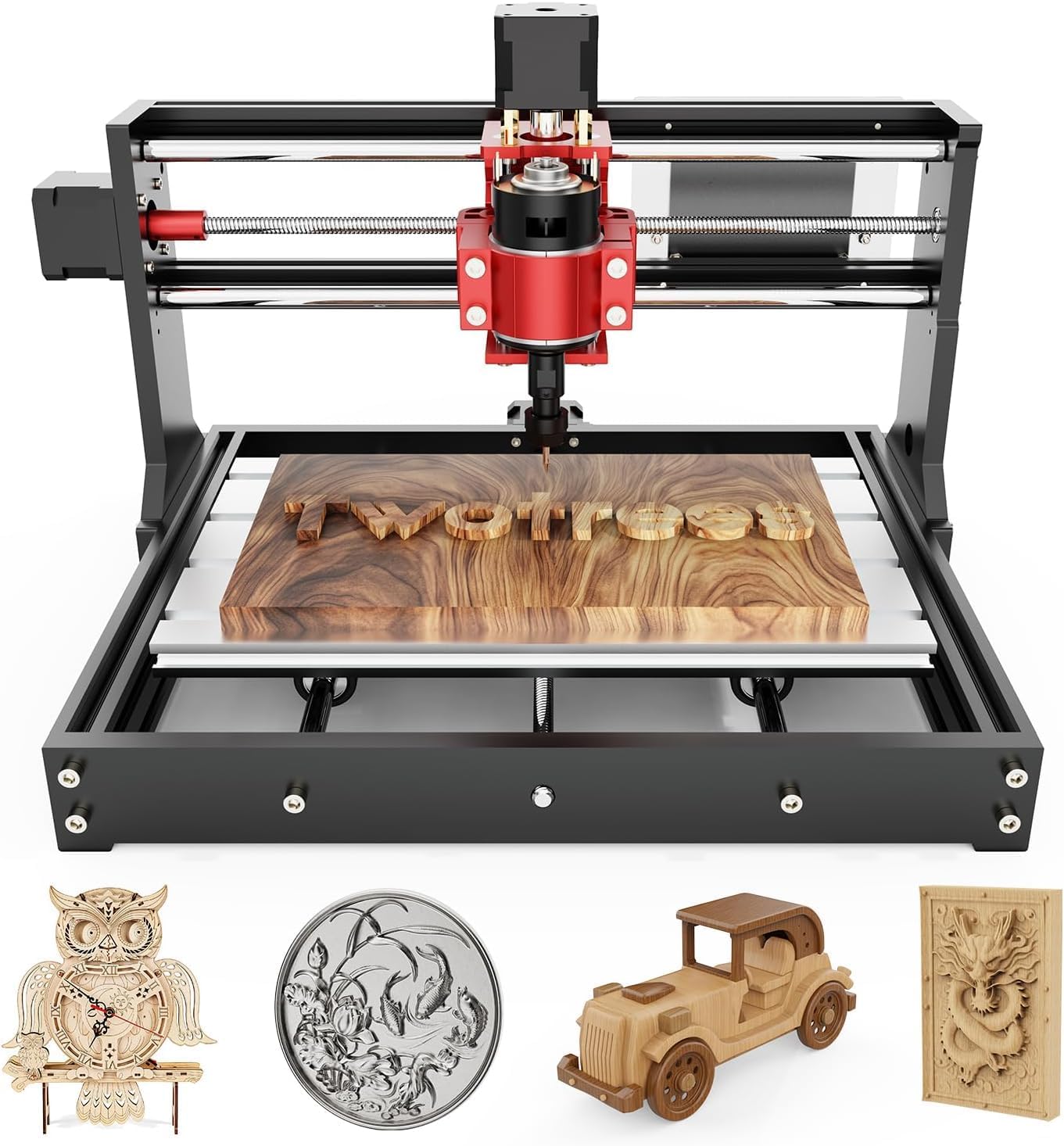
- 300 × 180 × 40 mm
- 775 brushed spindle, ER11 collet
- All-metal frame
The lower-cost Twotrees 3018: a 300 × 180 × 40 mm working area, a 32-bit STM32 controller running GRBL, and a 775 spindle with an ER11 collet on a frame that arrives mostly assembled.
The TTC3018 is Twotrees' entry into the 3018 format, and the board is where it departs from the older kits. GRBL runs on a 32-bit STM32 processor rather than the 8-bit Arduino-class chip that the original GRBL was written for. For the owner, the practical result is a controller with headroom for smooth motion at the machine's 1,500 mm/min top speed.
The rest of the package reads like a 3018 that wants to be running the same evening:
Twotrees quotes 0.1 mm engraving accuracy. Treat that as the frame's best case with a sharp bit and well-held stock; bit runout and clamping set the real number on any given job.
Pine is the natural first material. It cuts fast and forgives a poor feed rate, and a coaster engraved with a V-bit shows at once whether the axes are square and the zero is right.
| Spec | Value |
|---|---|
| Model | Twotrees TTC3018 |
| Working area (X × Y × Z) | 300 × 180 × 40 mm |
| Machine size | 420 × 355 × 280 mm |
| Controller | 32-bit STM32 processor |
| Firmware | GRBL |
| Engraving accuracy (maker's figure) | 0.1 mm |
| Maximum speed | Up to 1,500 mm/min |
| Spindle | 775 motor |
| Spindle speed | 7,000–9,000 rpm |
| Collet | ER11, holds 0.5–7 mm shanks |
| Connection | USB |
| Design software named | ArtCAM, Fusion 360 |
| Supported OS | Windows XP to Windows 10 |
| Assembly | Main components pre-assembled, cables labelled |
| Certifications | CE-EMC, CE-LVD, CE-MD, CE-RED, RoHS, FCC SDoC, FCC ID |
| Warranty | 1 year from the manufacturer |
| EU spare-part availability | 7 years |
| Colour | Black |
Twotrees sells the TTC3018 as both a router for wood and plastic and a light-duty mill for soft metals such as copper and aluminium. The spindle is what sets the terms. A 775 running at 7,000–9,000 rpm is slower than the 10,000-plus rpm of some 3018 motors, which changes the feed rate every material wants.
The standard chip-load arithmetic shows why. Feed rate equals spindle speed times flute count times chip load per tooth:
Those chip loads are illustrations, not a recipe; the right figure depends on the bit's diameter, coating and sharpness. What the maths makes clear is that a slower spindle suits slower feeds, which suits this frame anyway.
| Material | How it goes on a TTC3018 |
|---|---|
| Pine, basswood, plywood | Fast, clean, the machine's comfort zone |
| Cast acrylic | Clean with an O-flute and light passes |
| Brass and copper sheet | Engraving and very light profile cuts |
| Aluminium | Tags and shallow engraving, 0.1–0.2 mm per pass |
Acrylic deserves one extra note at these speeds. The same chip-load rule applies: a feed that is too slow for the spindle speed makes the bit rub, and rubbing melts the chips back into the slot. Aim for crisp curls rather than dust or goo.
The TTC3018 connects over USB and speaks GRBL, so the software chain is the standard one for the format. A design program makes the toolpath, a sender streams the G-code, and the board turns it into steps. Twotrees names ArtCAM and Fusion 360 for design and supports Windows XP through Windows 10.
Because the board runs GRBL, the usual free senders for 3018 routers are the natural fit alongside the included software. The 3018 software rundown compares Candle, UGS, Easel and Carveco.
Details worth checking before the first long job:
There is no offline controller or memory-card slot in the box, so the laptop stays connected for the whole run. Plan the bench around a USB cable that will not snag the gantry.
Keep the laptop's sleep settings off for long jobs as well. A computer that sleeps halfway through a two-hour carve stops the stream, and GRBL halts with the bit sitting in the wood.
Both Twotrees machines share the 300 × 180 × 40 mm working area, the 775 spindle at 7,000–9,000 rpm, the ER11 collet and GRBL control over USB. Twotrees markets the all-metal Z axis with a T8 anti-backlash leadscrew as the Pro's upgrade, along with a kit of ten cutters.
| If the plan is | Take |
|---|---|
| Wood, plastic and acrylic at the lowest cost | TTC3018 |
| Aluminium and brass sheet as a regular job | TTC3018 Pro |
| An offline controller and the widest parts supply | Genmitsu 3018-PRO |
| Limit switches and an E-stop included | Genmitsu 3018-PROVer V2 |
The upgrade path matters too. A 3018 bought for wood often drifts toward brass nameplates or aluminium brackets within a few months, and the Z carriage is the part that limits that move. Buying the Pro once can cost less than buying the plain frame and a metal Z later, so be honest about where the hobby is heading.
A short list for a TTC3018 buyer:
Among the machines most bought last month, this is the lowest-cost 3018 of the group, which makes it a sensible first frame for learning GRBL and CAM without a big outlay. What each price band adds is on the 3018 price page.
A 32-bit STM32 board running GRBL, connected to the computer over USB.
Its 775 spindle runs at 7,000–9,000 rpm and takes bits from 0.5 to 7 mm through the ER11 collet.
Light engraving and shallow cuts in copper and aluminium, yes. For regular metal work, the TTC3018 Pro's all-metal Z is the better choice.
No offline controller comes with it, so a computer stays connected over USB while a job runs.
The Pro keeps the bed, spindle and control and adds an all-metal Z with a T8 anti-backlash leadscrew and a set of ten cutters.